Necessities of Life: Food, Clothing and Shelter Week
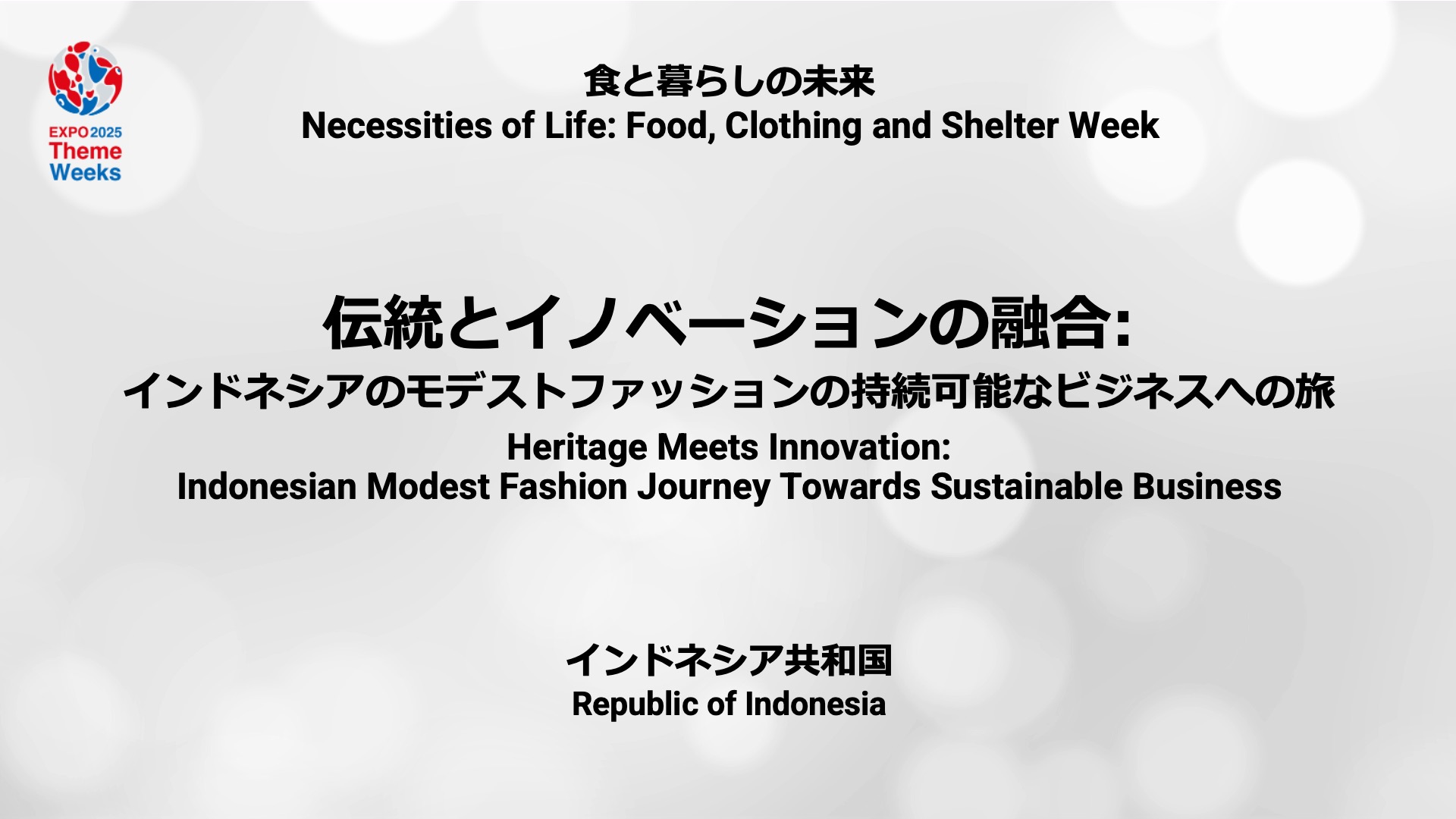
Heritage Meets Innovation: Indonesian Modest Fashion Journey Towards Sustainable Business
Republic of Indonesia
One of the key sustainability challenges addressed at Expo 2025 is the fashion industry’s environmental impact.
Recorded video available
Discussion
- Sustainable fashion
- Ethical consumption
| Transmission of simultaneous interpretation | Provided |
|---|---|
| Language of interpretation | Japanese and English |
-

Track Programme
-
Time and
Date of
the event -
-
2025.06.13[Fri]
10:00 ~ 12:00
(Venue Open 09:30)
-
- Venue
- Pavilion
- Indonesia Pavilion
Programme details
*Subtitles: Choose “Subtitles/CC” in the “Settings” (gear
icon) at the bottom right of the YouTube video.
*Subtitles may not show with multiple languages or overlapping
audio.
As one of the largest contributors to water pollution, carbon
emissions, and textile waste, the fashion sector is under
increasing pressure to adopt sustainable practices. Consumers
are demanding eco-friendly alternatives, ethical sourcing, and
circular economy solutions.
Businesses must take action to transition towards a more
responsible and sustainable future.
The Sustainable Fashion Business Forum at the Indonesia
Pavilion will bring together industry leaders, policymakers,
and sustainability advocates to discuss innovative solutions,
responsible business practices, and collaborative efforts in
promoting sustainable fashion.
Reports
【Reflection】
This programme, themed around the “Fusion of Culture and
Sustainability”, featured three leading brands from
Indonesia’s creative industries. Each brand took the stage to
showcase their products and share the stories behind their
businesses.
The first to present was Java Cressman, a brand that crafts
handmade bags using natural materials such as rattan and
banana stems. Their “Ohana” series is inspired by Japanese
flowers, expressing the beauty of nature and the power of
renewal. The products are infused with the craftsmanship of
artisans from Yogyakarta, Indonesia, contributing
significantly to local employment and the preservation of
traditional skills.
Next, Hijack Sandal introduced their sustainable footwear
brand, known for its use of recycled materials and natural
rubber. Their products balance fashion with environmental
consciousness, positioning the brand as a leader in circular
fashion. Beyond adopting low-impact manufacturing processes,
the company also considers the entire product life cycle,
demonstrating a holistic approach to sustainability.
Finally, Colla the Label, a women’s fashion brand based in
Bandung, showcased its vibrant and distinctive designs made
from 100% natural fibres. With the pansy flower as its brand
symbol, the collection communicates themes of resilience and
renewal, reflecting the journey beyond the COVID-19 pandemic.
The brand reaches a wide range of customers through both
domestic and international stores, as well as online
platforms.
Towards the end of the session, a Q&A segment was held,
with many questions and positive feedback from Japanese
attendees. Rather than merely introducing products, each
presentation conveyed cultural value and social impact,
effectively highlighting the global potential of Indonesia’s
creative industries.
【Post EXPO Initiatives】
Building on the success of the programme, all three
participating brands have continued to actively pursue
opportunities in the Japanese and wider international
markets.
Java Cressman has been exploring new distribution channels in
Japan, drawing on the feedback received during the exhibition.
Future plans include participation in pop-up events and trade
fairs, alongside developing products tailored to the Japanese
market. The brand is also seeking local partnerships to
enhance its visibility as a sustainable business.
Hijack Sandal, which has already gained recognition across
Southeast Asia, is now positioning Japan as a key strategic
market. The company is actively seeking distribution partners
and exploring collaborative promotional opportunities. Its
commitment to recycling and material recovery has been noted
as aligning well with Japan’s circular economy goals. In
addition, the brand is working to further enhance its
environmentally responsible design and production systems to
meet international green standards.
Colla the Label, encouraged by the positive reception from
Japanese audiences, is considering strengthening its
cross-border e-commerce presence and launching limited-time
retail spaces in Japan. The brand’s message of resilience,
embodied by the pansy flower, has resonated strongly with
Japanese consumers. As such, it is also exploring the
development of Japan-specific collections and accelerating
promotional efforts.
All three brands continue to build their presence in global
markets by promoting distinctive value propositions grounded
in sustainability, cultural heritage, and social impact.
Leveraging the networks and insights gained through Expo 2025,
they are expected to deepen international collaboration and
contribute to the long-term development of regional economies
and artisanal traditions.
Necessities of Life: Food, Clothing and Shelter Week
Heritage Meets Innovation: Indonesian Modest Fashion Journey Towards Sustainable Business
One of the key sustainability challenges addressed at Expo 2025 is the fashion industry’s environmental impact.
-
2025.06.13[Fri]
10:00~12:00
(Venue Open 09:30)
- Pavilion
OTHER PROGRAM
Necessities of Life: Food, Clothing and Shelter Week