The Future of Community and Mobility Week
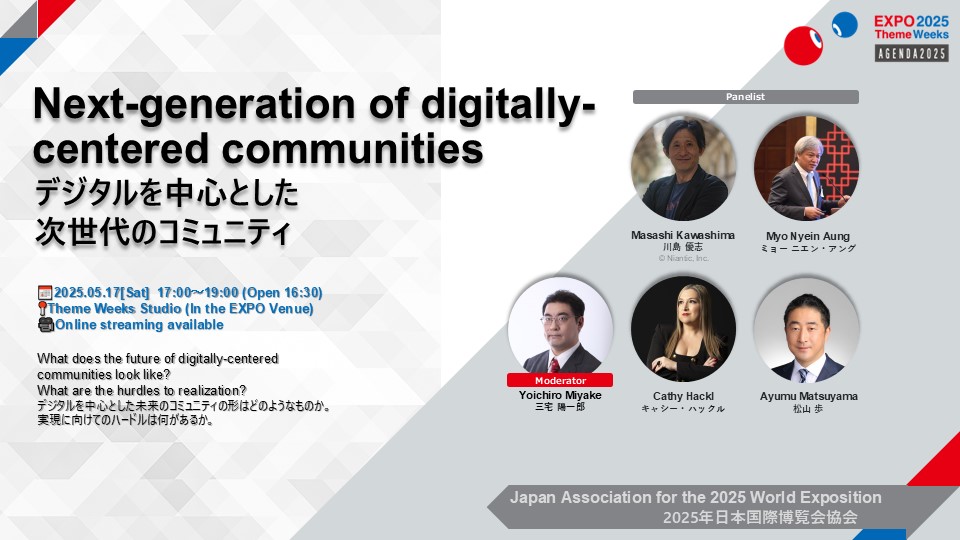
Next-generation of digitally-centered communities
Japan Association for the 2025 World Exposition
The programme, together with the General Sponsors, explores: 'What does the future of digitally-centered communities look like? What are the hurdles to realization?'
Recorded video available
Discussion
- Others
| Transmission of simultaneous interpretation | Provided |
|---|---|
| Language of interpretation | Japanese and English |
-

Agenda2025
Organised Programme
-
Time and
Date of
the event -
-
2025.05.17[Sat]
17:00 ~ 19:00
(Venue Open 16:30)
-
- Venue
- Theme Weeks Studio
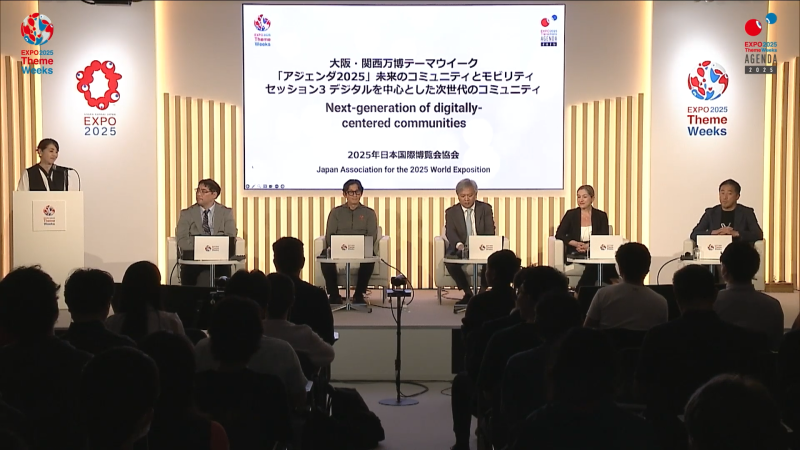
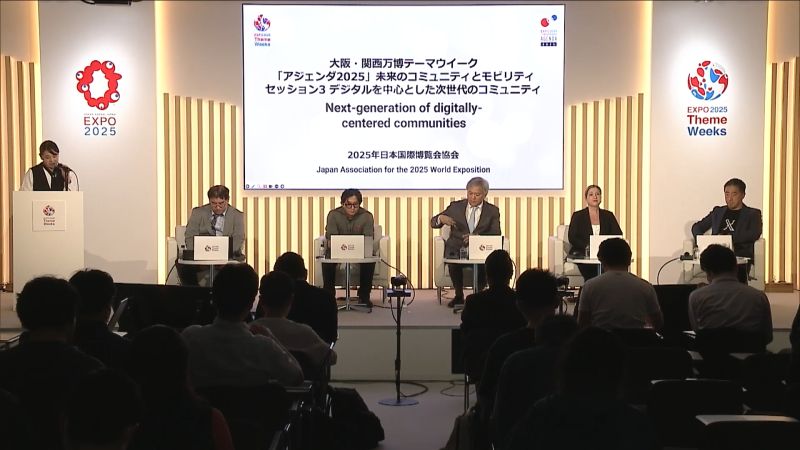
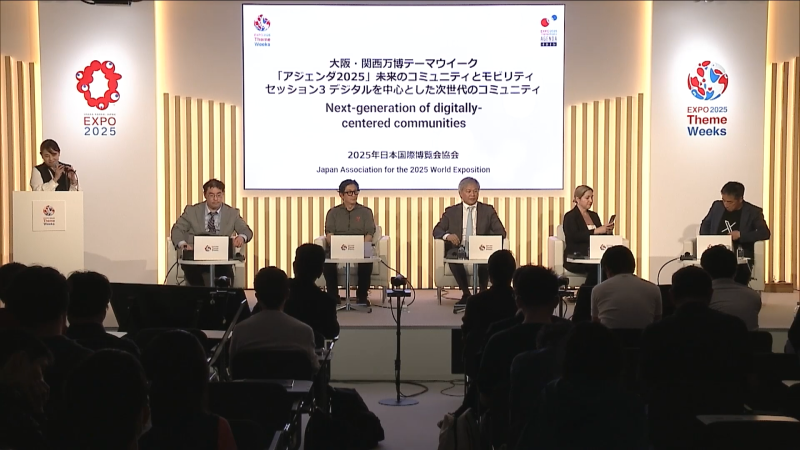
Programme details
*Subtitles: Choose “Subtitles/CC” in the “Settings” (gear
icon) at the bottom right of the YouTube video. *Subtitles may
not show with multiple languages or overlapping audio.
Media on the Internet has been evolving and developing to lead
to linkage of peoples from all walks of life that transcends
distance and culture, so that new forms of community have
emerged there. In this programme, we will invite leading
figures from the world of media to talk about the formation
and development of online communities in their respective
media, and their outlook for the future. They will also
discuss the role that online communities play in society, and
the creation of new values, from the perspective of managing
online communities, and explain their outlook for the future.
If you are interested in the future of media and trends in
online communities, this is a rare opportunity to hear from a
range of prominent guests, so please join us.
Reports
【Session Summary】
The session titled “Next-generation of digitally-centered
communitiess,” held on May 17, 2025, during the “Future of
Community and Mobility” theme week, explored the fundamental
question: “What kinds of communities will be shaped through
digital technology in the future?” Organized as part of the
Agenda 2025 initiative, the session considered both online and
offline perspectives to envision a future society grounded in
the crossing of cultures and values.
Rather than treating “digitally centered communities” as an
abstract philosophical concept, the session approached it as a
real-world implementation issue, engaging with the integration
of technology, culture, and systems. The discussion elevated
the topic into a practical vision for the future, where
digital communities are not just a product of tools but a
critical part of inclusive societal infrastructure.
Designing futures that integrate online and offline realities
offered an opportunity to redefine what “transboundary
co-creation” can mean in a digitally interconnected age.
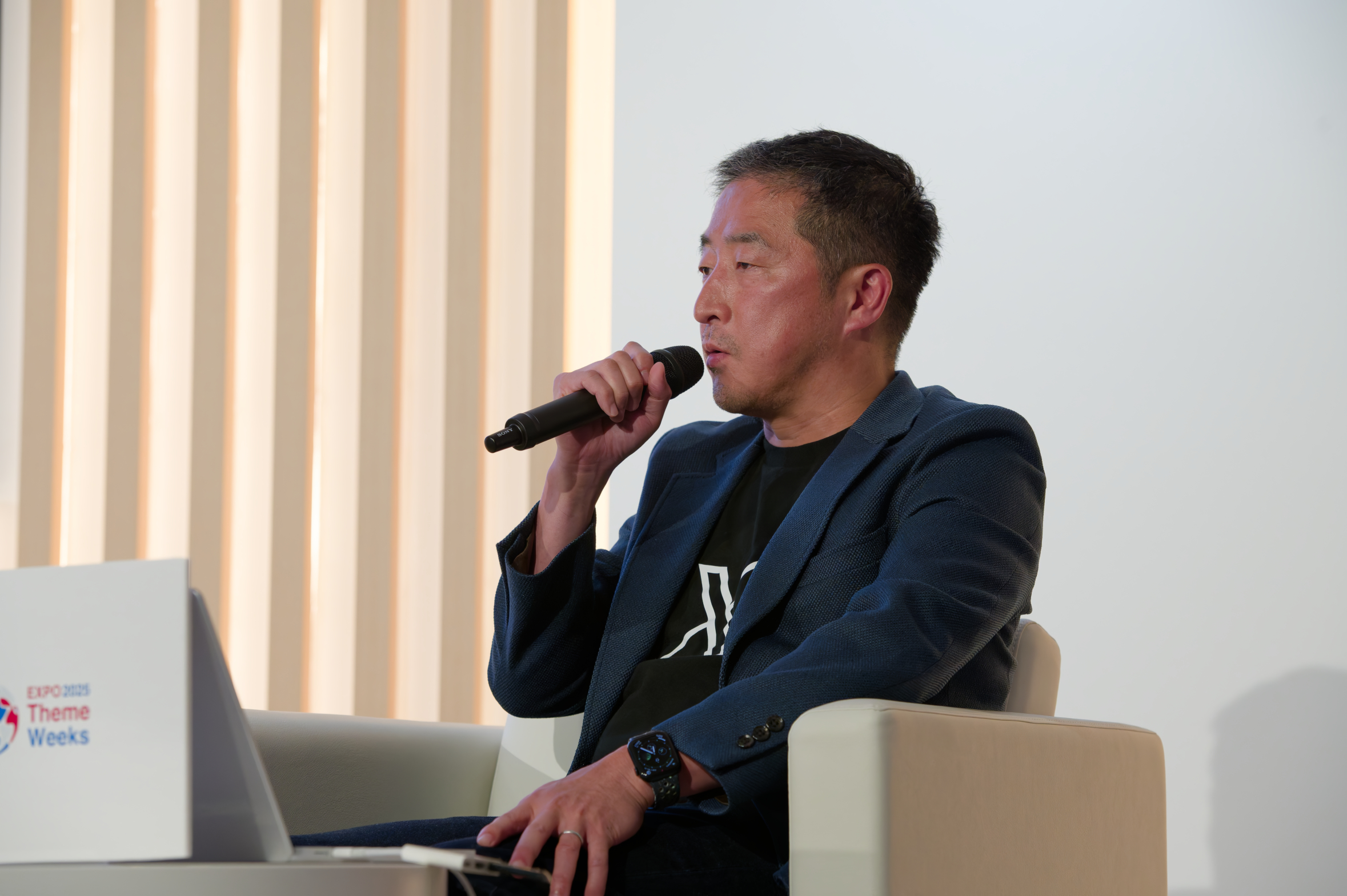
【Speaker Summary: Yoichiro Miyake】
Yoichiro Miyake, serving as the session's moderator,
offered a stimulating and intellectual perspective that
combined game AI, the metaverse, urban spatial theory, and
philosophy to explore the theme of “digitally driven
next-generation communities.” Drawing on his extensive
research in game artificial intelligence and the social
structures of digital spaces, Miyake guided the session
through the central question of how new forms of community
emerge in the convergence of real and virtual worlds.
At the outset, he addressed the division between physical and
digital spaces in contemporary society. As shared values once
represented by “cities” or “nations” become fragmented, he
argued that we must redesign how human connections are formed.
Technologies like the metaverse and XR, he suggested, should
be redefined not merely as tools but as platforms that mediate
collective intelligence and empathy.
Miyake also examined the nature of “identity” and “personhood”
in digital spaces, highlighting how individuals can
participate in society through multiple avatars or digital
selves. This “multiplicity of self” points to an emergent
ethical and social model that understands identity and
relationships as fluid and dynamic.
He presented examples from gaming spaces—such as cooperative
play and asynchronous connections—as novel forms of
collaboration that do not exist in traditional urban
communities. These, he suggested, should inspire new models
for restructuring real-world society.
Throughout the session, Miyake skillfully facilitated the
dialogue by organically linking the panelists’ diverse
expertise around key themes such as embodiment and space,
language and platforms, economy and community, and death and
memory. He repeatedly emphasized the importance of
philosophical and ethical considerations in designing future
digital spaces, alongside technological development.
In closing, he stated, “We should aim for a society centered
not on technology itself, but on human dignity and
relationships.” He emphasized that the core of digital
community design lies not in convenience or efficiency, but in
empathy and inclusion. His moderation, blending intellect and
sensitivity, deeply engaged both speakers and audience,
elevating the session into a thought-provoking forum.
【Speaker Summary: Masashi Kawashima】
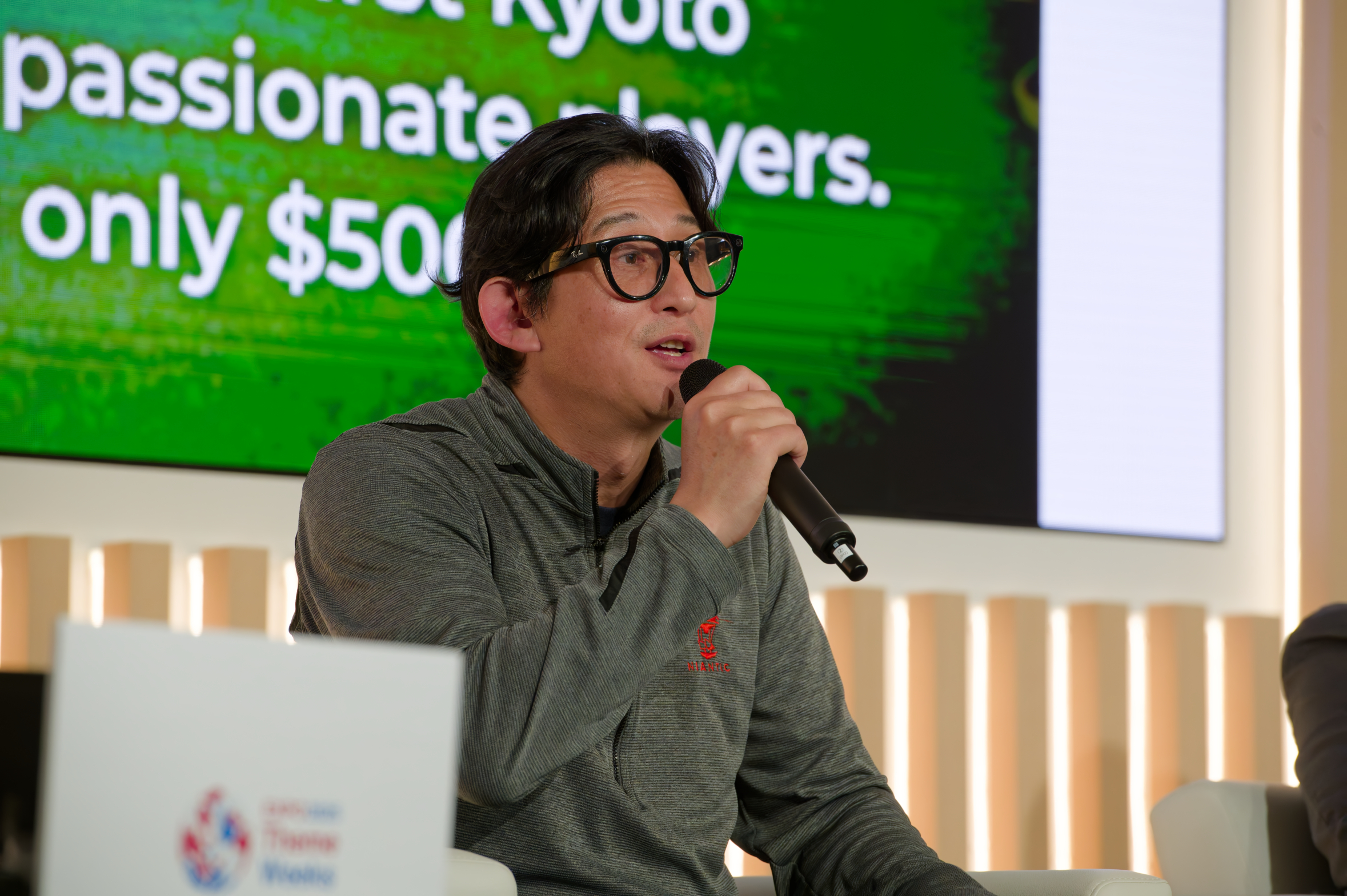
Masashi Kawashima, Vice President of Games/Publishing at
Niantic, Inc., offered practical insights into how communities
are shaped in a society where the physical and digital merge.
Speaking from his experience with AR-based platforms such as
Pokémon GO and Ingress, he emphasized that these services are
designed not simply as online games but as systems that create
opportunities for real-world social interaction.
Kawashima described AR’s greatest innovation as the
“reconstruction of meaning in place.” Locations are no longer
just transit points or passive backdrops—they are redefined as
layered realities where games, information, and communication
converge. This concept of “Layered Reality” generates new
narratives for urban and local spaces, reshaping people’s
relationships to their environments.
He highlighted Niantic’s vision of a “Real-World Metaverse,”
where digital experiences are grounded in physical presence
and space. Unlike closed virtual worlds, Niantic’s model
emphasizes serendipitous encounters and shared experiences in
the real world. Collaborations with local governments,
commercial facilities, and communities foster public
participation and co-creation, mediated by digital platforms.
Kawashima noted that player interaction is deliberately
designed into the platform, where “bringing people together”
is itself a form of social value. In addressing challenges
like isolation and social fragmentation, he proposed that AR
can be a powerful tool to enable shared presence.
A particularly striking message from his talk was that “it is
not technology but human intention and behavior that shape
communities.” No matter how advanced the technology, its
purpose and how it is shared must always be questioned. For
this reason, Niantic focuses on nurturing user communities,
encouraging independently organized events and ongoing
dialogue with localities, seeing users not merely as consumers
but as co-creators.
In conclusion, Kawashima emphasized, “It is not technology
alone that builds the cities and societies of the future—it is
how we use it and how we design systems to connect people.”
His remarks encouraged the audience to reconsider the
essential purpose of technology in fostering connection.
【Speaker Summary: Myo Nyien Ang】
Dr. Myo Nyien Ang, Associate Professor at Juntendo
University’s Graduate School of Medicine, provided deep
insight from the perspective of public and global health. She
discussed how digital technology can impact the health and
daily lives of vulnerable populations, including the elderly.
Her research focuses on the intersection of health,
technology, social inclusion, and evidence-based policymaking.
Ang began by highlighting the digital divide that became
apparent during the pandemic—particularly disparities in
access to information and digital literacy. For older adults,
immigrants, and people with disabilities, the shift to online
services often exacerbated isolation and health inequities.
She emphasized the urgent need for inclusive ICT education and
support systems.
She also stressed the importance of “multigenerational and
multicultural coexistence” in community design. Technologies
like XR and the metaverse, she explained, can facilitate
communication across generational, linguistic, and cultural
boundaries. In medical and elder care settings, tools for
remote interaction have already shown positive outcomes in
maintaining cognitive functions and providing psychological
comfort.
Ang introduced the concept of “cultural appropriateness” in
technology design, warning that if avatars’ appearances,
voices, or interfaces do not align with users’ cultural
contexts, they may provoke discomfort or exclusion. Therefore,
participatory and co-creative approaches are essential to
building inclusive systems.
From a policy perspective, she advocated for integrated
digital inclusion programs through cross-sector collaboration
in health, education, and social welfare. She emphasized the
importance of bridging practical insights from the field with
academic evidence.
Ang also cautioned against technology becoming an end in
itself, arguing that the most important factor is to maintain
a “human-centered perspective.”
In conclusion, she stated, “The communities we envision for
the future must be ones where technology expands, rather than
excludes, the possibilities for connection.” Her message
powerfully reaffirmed the ethical and human dimensions of
technological implementation.
【Speaker Summary: Cathy Hackl】
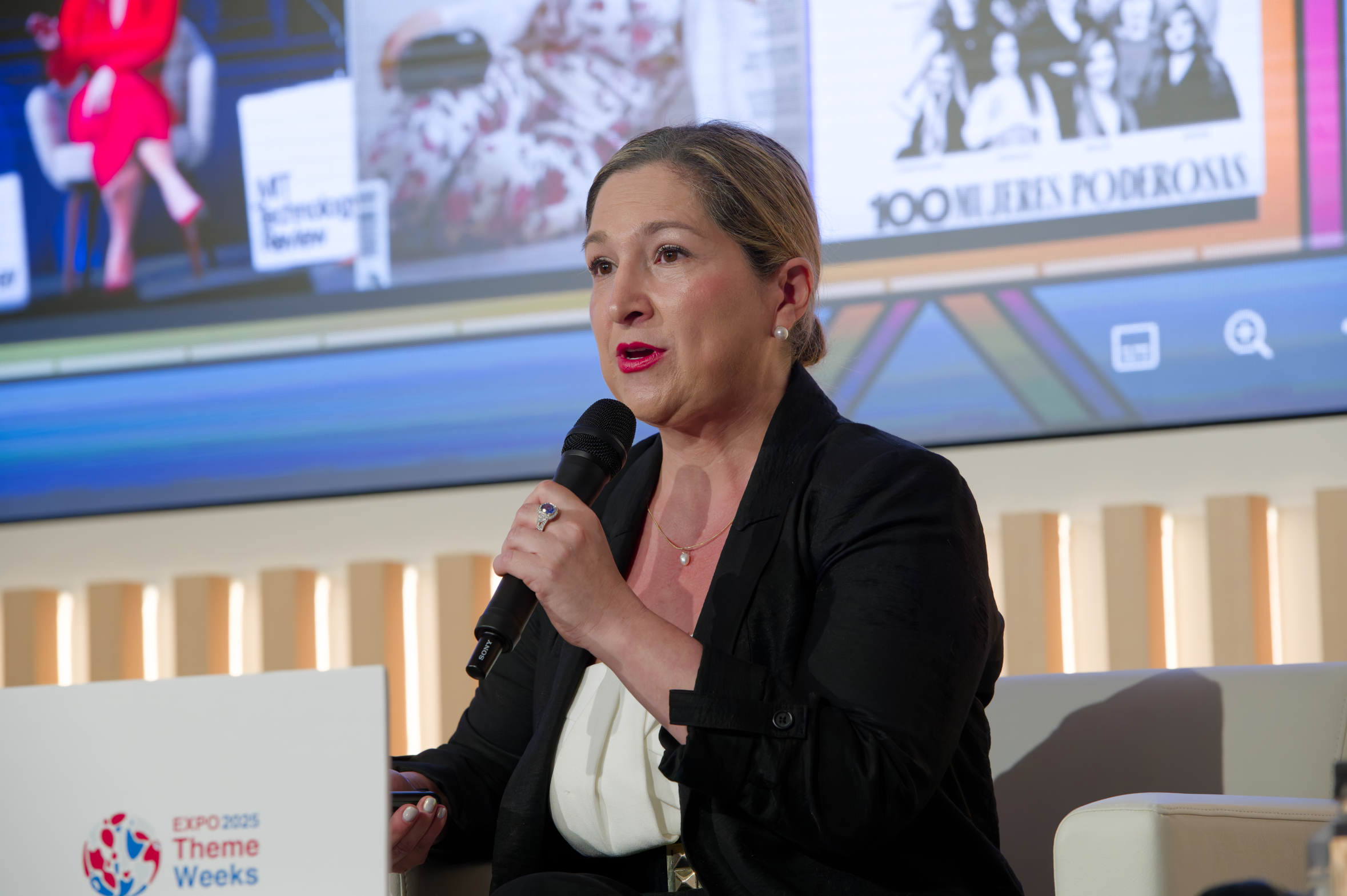
Cathy Hackl, CEO of Spatial Dynamics and a globally recognized
tech and gaming executive, futurist, and author, shared her
forward-looking vision of how space computing, the metaverse,
and AI are reshaping the foundations of digital communities.
With experience at leading companies such as Apple, Magic
Leap, and HTC Vive, she explored how human identity and
culture are being reconstructed in an age where the line
between virtual and physical reality is increasingly blurred.
Hackl described technology not merely as a tool, but as a
device that expands human imagination and creativity. She
emphasized that spatial computing is transforming how we
experience the world. In metaverse environments, people can
express themselves beyond physical, linguistic, or national
constraints, forming “fluid communities” that are diverse,
real-time, and co-creative.
She highlighted the metaverse’s growing role not just in
entertainment but as a platform for economic activity,
education, healthcare, and cultural expression. Technologies
such as NFTs and digital twins are increasingly integrated
into contexts like art, fashion, and urban design—where “space
= experience = economic value.”
At the same time, Hackl acknowledged the risks accompanying
these developments. She emphasized the need for the tech
industry to address issues such as data sovereignty, privacy,
inclusion, and cultural barriers. From the early stages of
development, she argued, it is crucial to incorporate diverse
user voices through “inclusive design.” She advocated for a
design philosophy that balances global standards with local
cultural perspectives, resisting a Western-centric view.
Hackl also pointed out the potential of the metaverse as a
space where underrepresented voices, including women and
minorities, can be empowered. Sharing personal and family
experiences, she described how XR and AI can stimulate empathy
and imagination, laying the groundwork for a more connected
future.
In closing, she declared, “The future is not built by
technology, but chosen through values.” Her vision underscored
the need for a multidisciplinary approach—encompassing
culture, economy, and ethics—in designing the communities of
the future.
【Speaker Summary: Ayumu Matsuyama】
Ayumu Matsuyama, President of X Corp. Japan (formerly
Twitter), discussed the formation of digital communities from
the platform’s perspective, addressing both its social
responsibilities and the future of social spaces. Positioned
at the intersection of media, advertising, and user
engagement, his talk deeply questioned how to balance public
interest and economic viability in digital environments.
He began by outlining the platform’s role in the
“democratization of information,” highlighting how X enables
real-time communication during social movements and disasters,
and functions as civic infrastructure. The resulting “global
town square” of shared information and emotion, he explained,
form the fertile ground from which digital communities grow.
However, Matsuyama also acknowledged the inherent tension
between freedom of expression and the protection from harmful
content. He emphasized that platform responsibility goes
beyond technological moderation—it also involves building
trust through transparent governance and dialogue with users.
He noted that communities on X are not limited by geography
but are instead formed through shared interests. These
interest-based networks generate new types of social
structure, distinct from traditional community bonds. Global
in scale yet intimate in feel, these groups exemplify new
possibilities for coexistence based on shared emotions.
Matsuyama also addressed advertising, emphasizing the
importance of “communication rooted in user empathy.” As
algorithms often fail to fully capture human emotions and
contexts, understanding these subtleties is a key challenge
for future platform design. Advertising, he suggested, should
also be seen as part of cultural co-creation.
In closing, Matsuyama stated, “In an age where technology
connects people, the most important question is why we
connect.” He emphasized that the ethical dimension—the quality
and purpose of connection—must guide the design of future
digital communities. His talk pointed toward a future of
social media centered on meaningful human dialogue.
【Discussion Summary】
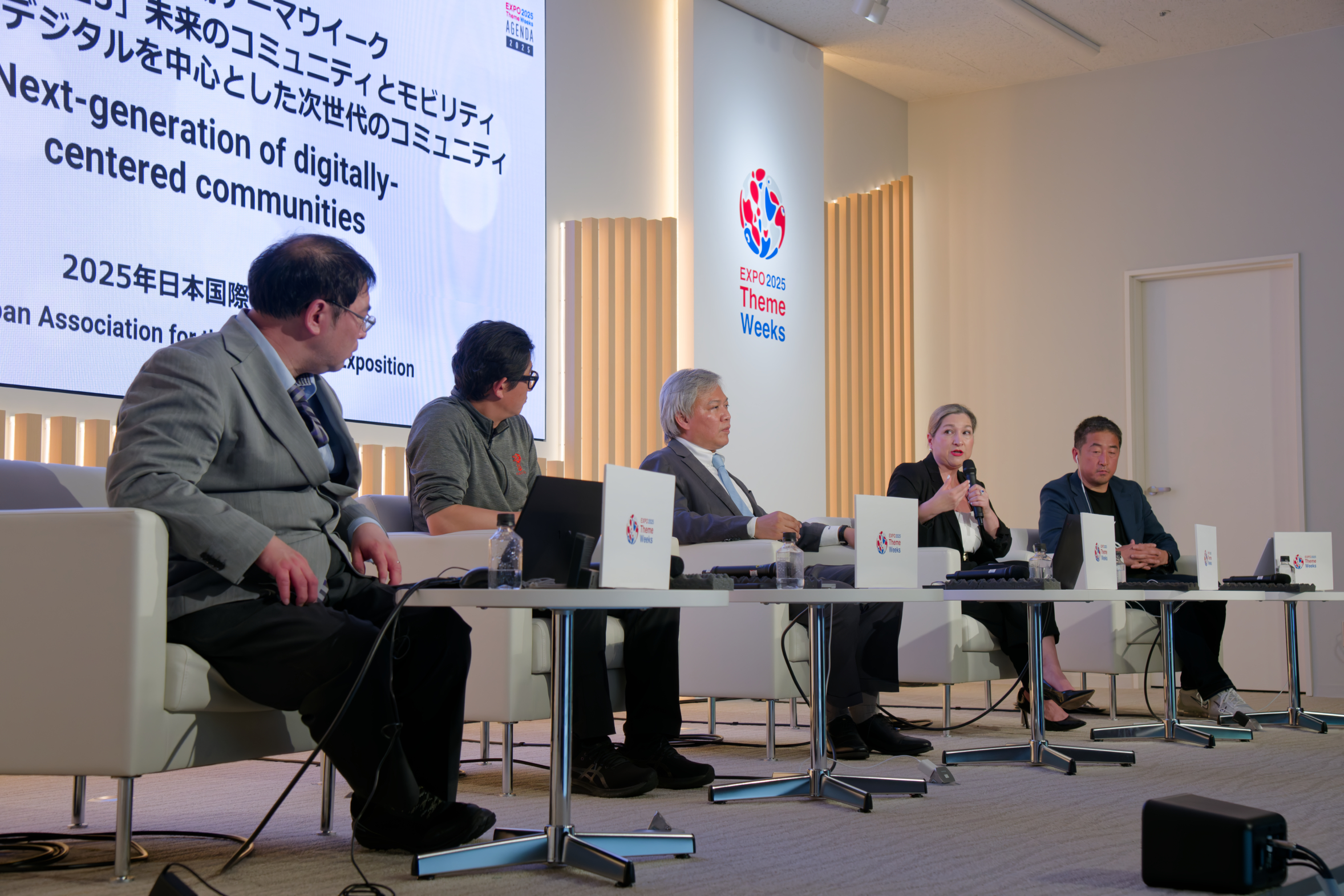
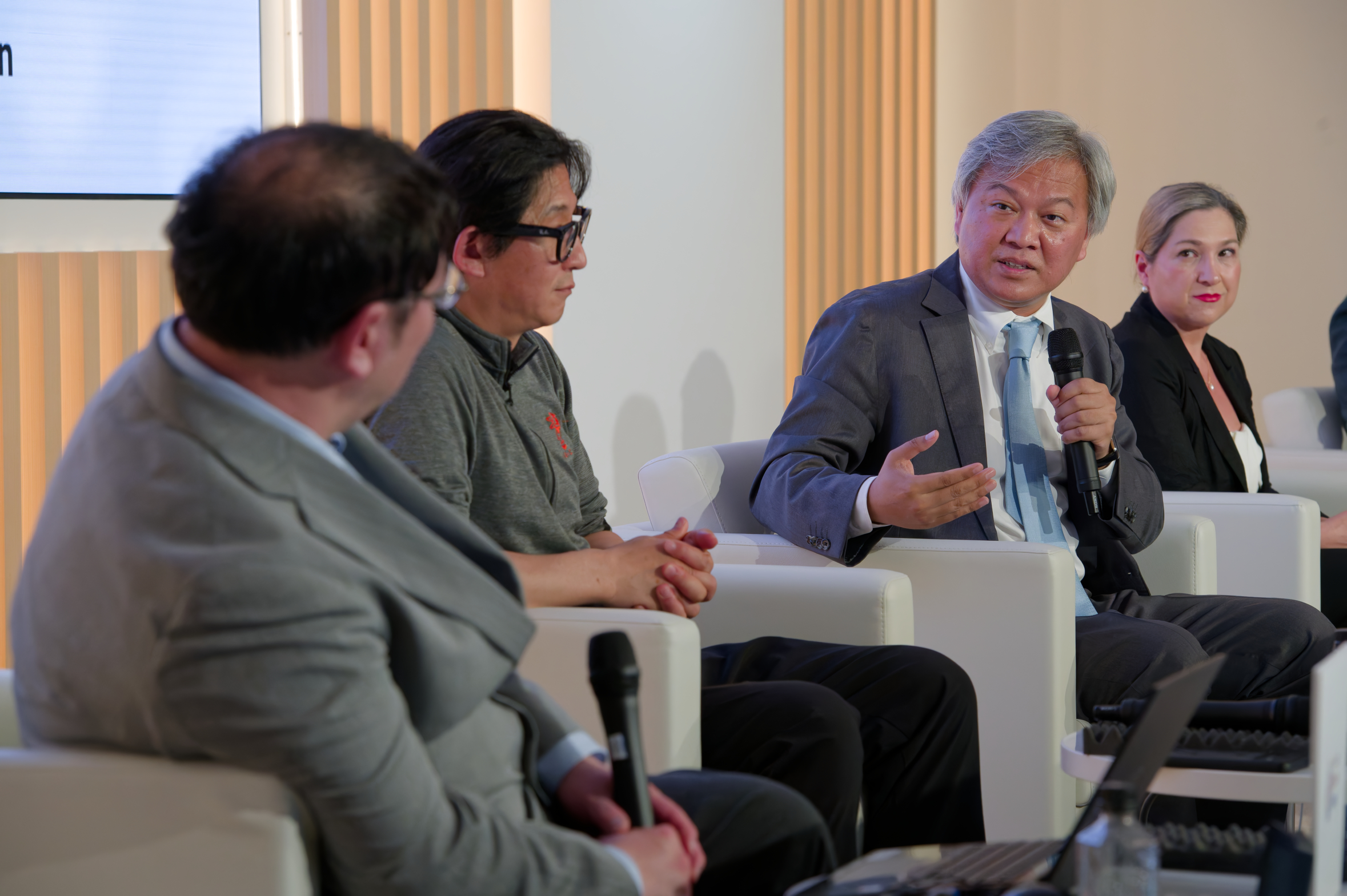
In the second half of the session, a cross-sectoral panel
discussion was held with all speakers. Centered around
questions such as “How should digitally driven next-generation
communities be formed?” and “What social meaning emerges from
the fusion of physical and digital realities?”, the dialogue
explored diverse and intersecting perspectives.
Moderator Yoichiro Miyake opened by defining communities as
“assemblages of people who share a certain time, space, and
value.” In an era where these elements now extend into digital
realms, he emphasized the need to design new models of empathy
and co-creation. Responding to this, Masashi Kawashima
explained how Niantic’s games facilitate spontaneous
encounters in real-world spaces, and how “place-centered”
social structures can influence regional engagement and
economies.
Dr. Myo Nyien Ang offered a perspective rooted in health and
welfare, warning that for the elderly and socially
marginalized, the very tools of connection could become
mechanisms of exclusion. She stressed the importance of
user-centered design and inclusive social policies that must
accompany technology implementation.
Cathy Hackl, drawing on a global viewpoint, emphasized the
ethical design of spaces that transcend physical and cultural
boundaries. She argued that including diverse
voices—especially those of women and minorities—enhances both
the creativity and sustainability of communities.
Ayumu Matsuyama reflected on how “interest-based” connections
on X (formerly Twitter) are generating novel social
architectures that differ from traditional community bonds. He
explored the intersection of trust and media functions in
digital spaces, and the challenge of creating “warm
connections” between algorithmic efficiency and human
sensitivity.
Throughout the discussion, a shared recognition emerged:
digital technology has the potential to connect people across
space and identity, but its design and governance must be
rooted in deep ethical consideration. In an era where the
boundaries between real and digital are dissolving, the
challenge is to live with technology while maintaining a
human-centered perspective.
Miyake concluded, “The future of communities will be shaped
not by technology, but by how we empathize with and include
others.” His closing statement framed a powerful question for
all participants—both philosophical and practical—at the
intersection of digital technology and social design.
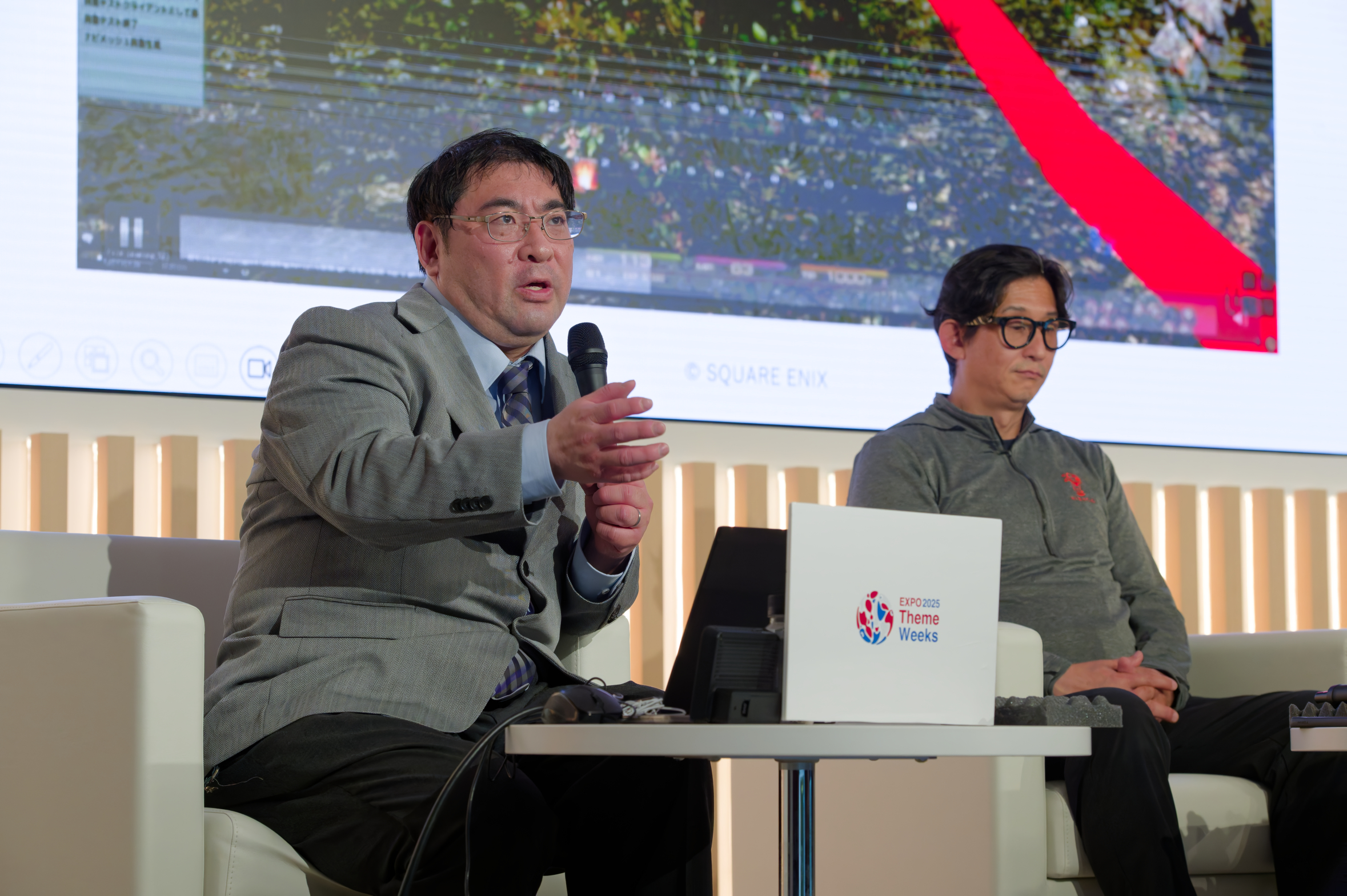
Cast
Moderator
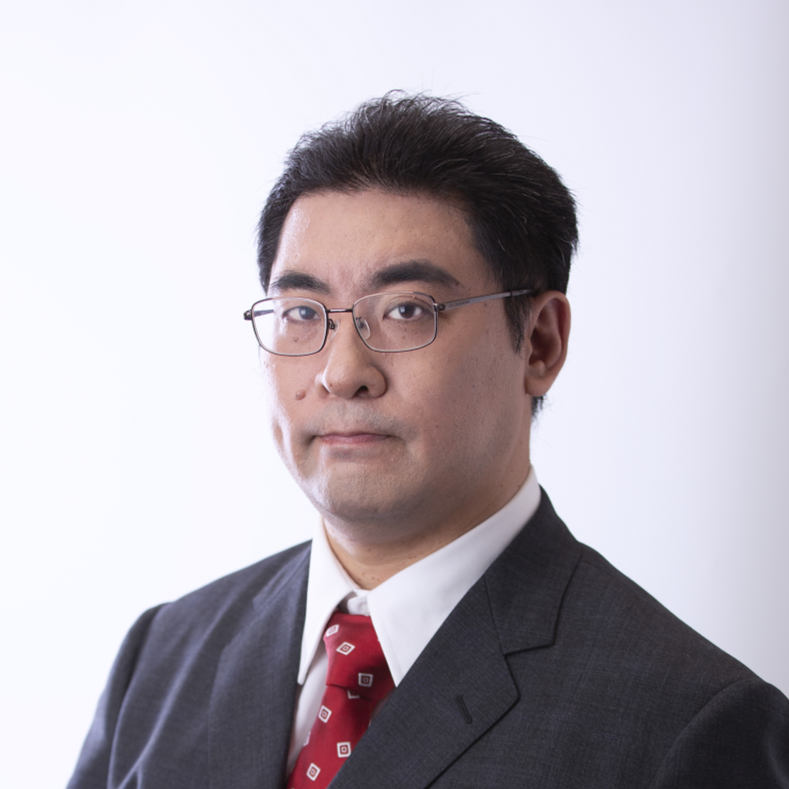
Yoichiro Miyake
Specially appointed professor,Institute of Industrial Science, the University of Tokyo
He researches and develops “artificial intelligence for digital games”, and aims to apply it to the real world as “spatial AI”. He majored in mathematics at Kyoto University, and has a master's degree in physics from Osaka University and a Ph.D. in engineering from the University of Tokyo. He is a specially appointed professor at Institute of Industrial Science, the University of Tokyo, a specially appointed professor at the Graduate School of Artificial Intelligence and Science, Rikkyo University, a visiting professor at Kyushu University, a board member of the Digital Games Association of Japan, and a board member and chair of the editorial committee of the Japanese Society for Artificial Intelligence.
View Profile
Close
close
Speakers
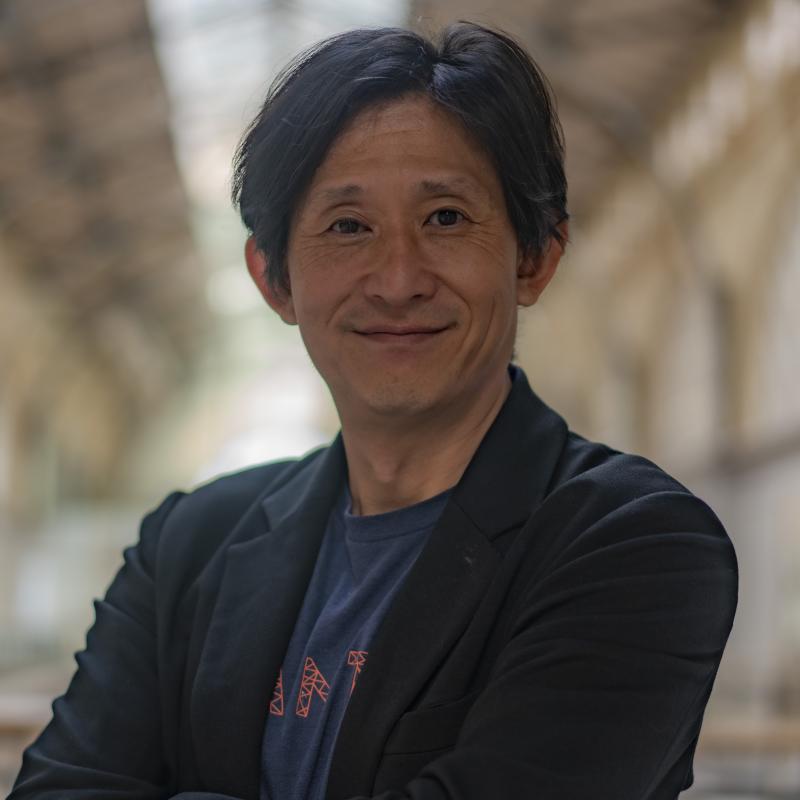
©Niantic, Inc.
Masashi Kawashima
VP, Games & Publishing, Niantic, Inc.
Masashi Kawashima is Vice President of Publishing
(Ingress, Peridot). Niantic initially started as a
“startup” within Google, and spun out from Google in
October 2015. He joined Niantic Labs in 2013 as a
UX/Visual designer and designed Ingress’ visual and
user experiences.
Masa also contributed to the launch of a new
ground-breaking project for mobile game called
“Pokémon GO”, in which players can look for and
capture Pokemon in the real world.
View Profile
Close
close
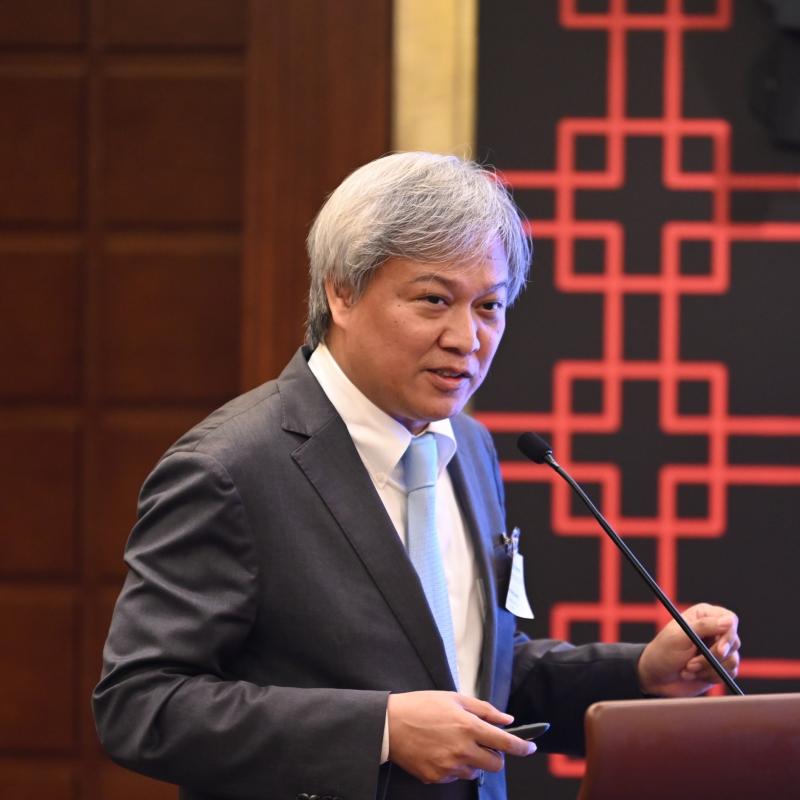
Myo Nyein Aung
Associate Professor, Department of Global Health Research, Graduate School of Medicine, Juntendo University
Dr. Myo Nyein Aung MD, MSc, PhD is an Associate
Professor in the Department of Global Health Research
at the Graduate School of Medicine, Juntendo
University,Tokyo, Japan. He is also affiliated with
the Juntendo Advanced Research Institute for Health
Sciences and the Faculty of International Liberal
Arts. Dr. Aung is the principal investigator of the
Digitally Inclusive Healthy Ageing Communities
(DIHAC), a cross-cultural study in, Japan, the
Republic of Korea, Singapore, Thailand and India. In
2024 He was invited several times by UN-ESCAP and
international conferences to talk about digital
literacy for older persons.
He is dedicated to health promotion, community-based
social innovation for healthy ageing, and digital
inclusion research internationally. His current
research focuses on empowerment models of older
people’s digital inclusion in cross-cultural contexts.
He organized series of multidisciplinary meetings
entitled as DIHAC meetings that are being participated
by academics and professionals from Asia, Europe,
Africa and America.
He is also the principal investigator of Community
Integrated Intermediary Care (CIIC) for Thai older
persons, a cluster randomized controlled trial funded
by the World Health Organization, The study
implemented and evaluated a new prevention based
long-term care model for low- and middle-income
countries. Furthermore, he conducted preventive
intervention, randomized controlled trials and many
observational studies in multi-disciplinary
approaches.
He teaches courses on global gerontology and policy in
collaboration with WHO, JICA, and JAGES study
experts,for graduate students. He has served as an
adviser for health systems strengthening low- and
middle-income countries, with JICA and USAID.
Dr. Aung has authored more than 80 original research
articles, with his work published in top journals such
as The Lancet and The Gerontologist. Research website
https://digital-ageing.com/
View Profile
Close
close

Cathy Hackl
Tech & Gaming Executive, CEO of Spatial Dynamics, Author, Keynote Speaker, Futurist, and Podcast Host
Cathy Hackl is a globally recognized tech & gaming exec, futurist, & speaker focused on spatial computing, virtual worlds, augmented reality, AI, & gaming platforms strategy. She’s the co-CEO of Spatial Dynamics, a spatial computing and AI solutions company & a top tech voice on LinkedIn. Hackl has worked at Amazon Web Services (AWS), Magic Leap, and HTC VIVE and has worked with companies like Nike, Ralph Lauren, Walmart, Louis Vuitton, & Clinique on their emerging tech & gaming journeys. As a sought-after keynote speaker, she’s spoken at Harvard Business School, MIT, SXSW, Comic-Con, WEF, CES, MWC, & more. She’s one of Ad Age’s Leading Women of 2023, was featured on the cover of Forbes Latam’s 100 Most Powerful Women 2023 issue, and is on the Vogue Business 100 Innovators inaugural list. She hosts Adweek’s highly successful TechMagic podcast and is popularly known in tech circles as the Godmother of the Metaverse. Cathy has been a fixture in the world of immersive technology for almost a decade with many media appearances in CNBC’s Squawk Box, 60 Minutes, CNN, Good Morning America, GQ, Time, The Economist, Bloomberg, and is a guest editor for Vogue Singapore. In 2022, she became the first human to ring NASDAQ’s opening bell and open the financial markets both in physical and avatar form while doing so on live television.
View Profile
Close
close

Ayumu Matsuyama
X Corp. Japan K.K. Representative Director
As Head of X Corp. Japan, Ayumu leads the overall advertising business in Japan. Since joining Twitter in 2014, he has overseen the advertising business for major domestic clients across the consumer goods and telecommunications industries. Prior to Twitter, Ayumu served as Division Head of Advertising at Microsoft Japan, where he ran Microsoft’s division in charge of advertising agencies. His career began in sales at Yomiuri Advertising Inc. from 1999 to 2005.
View Profile
Close
close
The Future of Community and Mobility Week
Next-generation of digitally-centered communities
The programme, together with the General Sponsors, explores: 'What does the future of digitally-centered communities look like? What are the hurdles to realization?'
-
2025.05.17[Sat]
17:00~19:00
(Venue Open 16:30)
- Theme Weeks Studio
OTHER PROGRAM
The Future of Community and Mobility Week