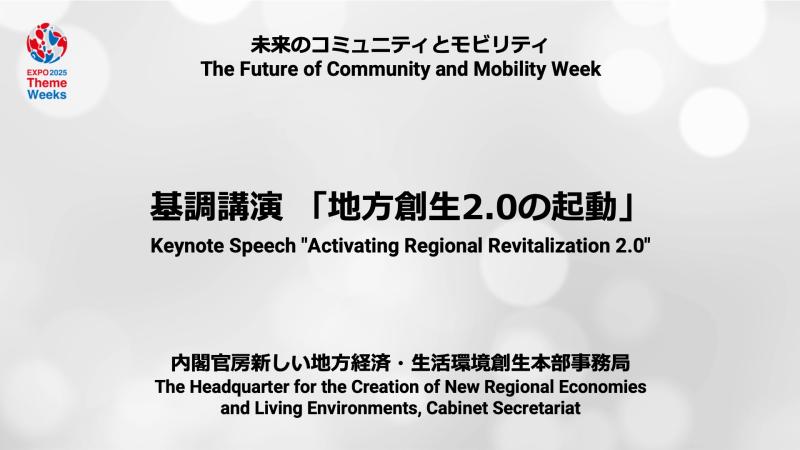
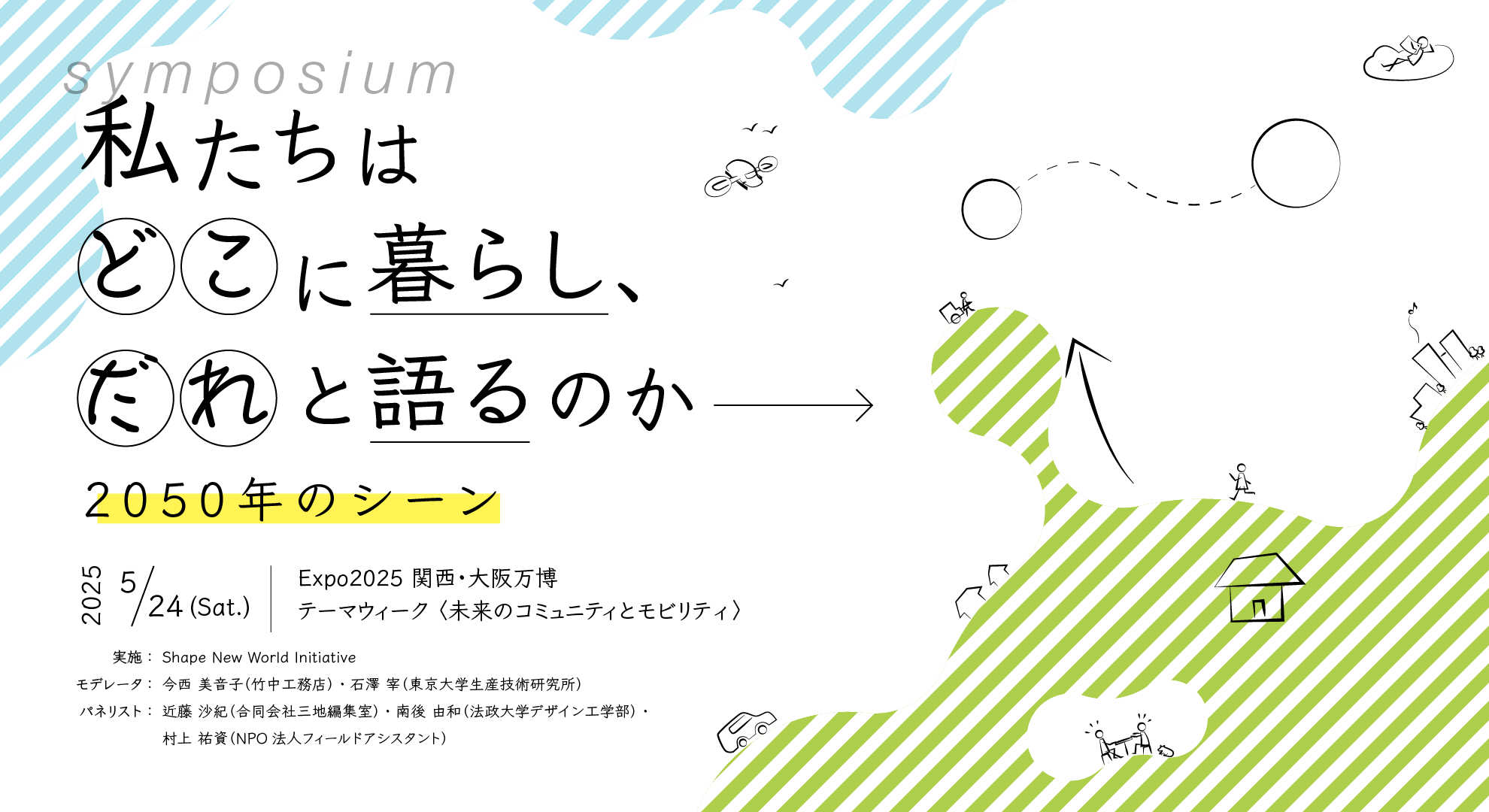
The Future of Community and Mobility Week
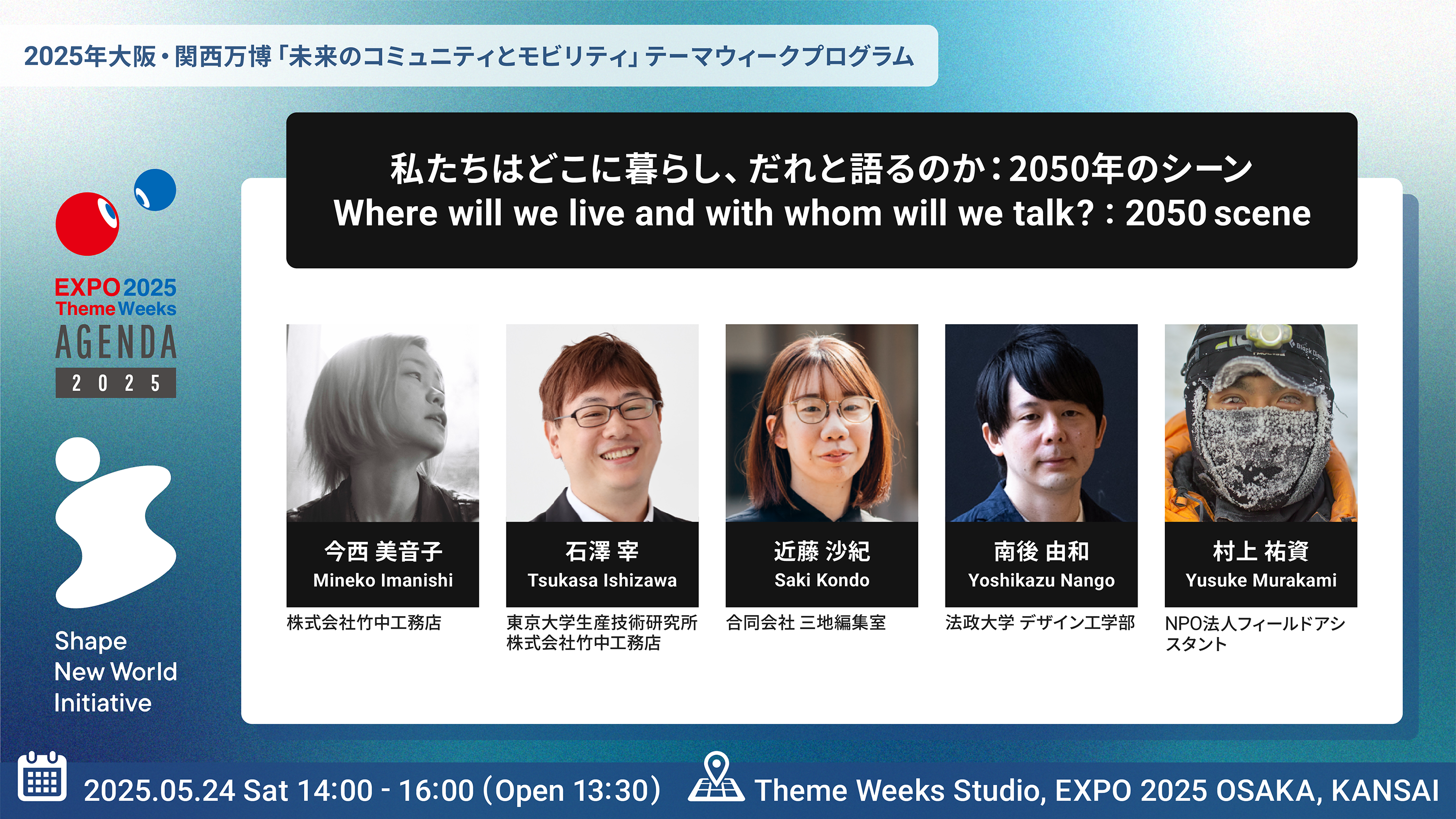
Where will we live and with whom will we talk?:2050 scene
Agenda 2025 Co-created Programme
Shape New World Initiative
[Hypothesis of the Future in 2050]
A future where people can more flexibly select and fly
around places to live.
With the advancement of technologies and the transformation
of society, the meaning of mobility and place has changed
and diversified. What kind of world will expand in the
future, and what kind of desires will we realize? The
panelists, who have experimented with various lifestyles,
will discuss scenes that can be envisioned in the near
future, 2050, interweaving the perspectives of practitioners
and people who live on.
Recorded video available
Discussion
- Digital garden cities
- Others
- multi-base living, life style
| Transmission of simultaneous interpretation | Provided |
|---|---|
| Language of interpretation | Japanese and English |
-

Agenda2025
Co-created Programme
-
Time and
Date of
the event -
-
2025.05.24[Sat]
14:00 ~ 16:00
(Venue Open 13:30)
-
- Venue
- Theme Weeks Studio
Programme details
*Subtitles: Choose “Subtitles/CC” in the “Settings” (gear
icon) at the bottom right of the YouTube video.
*Subtitles may not show with multiple languages or overlapping
audio.
Today, we can see people from long distances more frequently
through the power of transportation and communication. The
evolution and diversification of mobility enable us to travel
to and stay in more places than ever before. More and more
people now recognize diversity, and it is now possible and
required for each person to live according to their own
style.
The meaning of mobility and place is changing and will even
differ in 2050. Then, what do we want, and what can we do?
Finding a single answer to this question is difficult, though
we can consider some possible futures based on our
experiences, observations, and expectations.
In this session, we will engage in a collaborative discussion
about the scenes in 2050 and their challenges, interweaving
the perspectives of practitioners of various initiatives and
people who live on.
Reports
【Reflection】
In this program 'Where will we live and with whom will we
talk? 2050 scene: Agenda 2025 co-created program,'
dialogue was conducted to explore how our ways of living,
relationships with others, and the meaning of regions and
places will transform in a future society with increased
freedom of mobility.
The first session questioned the potential meanings that
community and mobility, the main themes of this symposium,
might hold in the future, while introducing the research
findings of 'Future Community and Mobility'
conducted by moderators Mineko Imanishi and Tsukasa Ishizawa
as part of their 'Research on Future Social Design.'
Based on their research, they presented potential lifestyles
in 2050 and outlined a roadmap of conceivable social and
technological developments that could lead to those
lifestyles.
The second session featured three speakers with different
perspectives, introducing their practical activities and
engaging in dialogue about our ways of living and the meaning
of place.
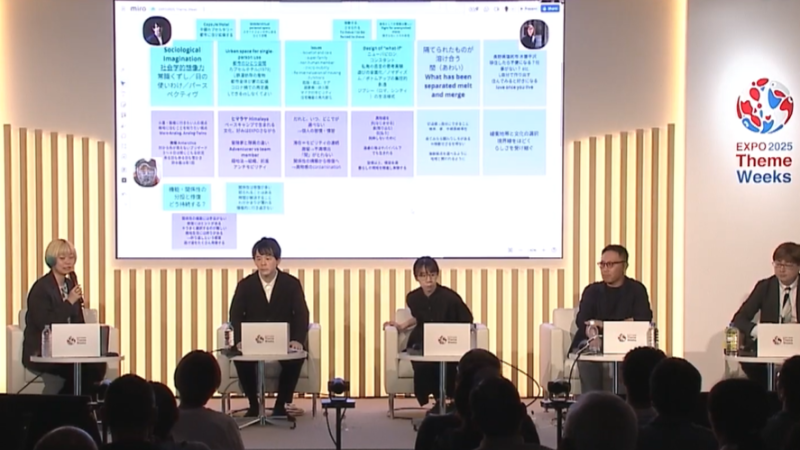
Yoshikazu Nango from Hosei University, specializing in
sociology and architectural/urban theory, introduced the
formation process of urban solitary spaces and their
redefinition during the COVID-19 pandemic, along with the
accompanying transitions in loneliness, isolation, and family
structures, viewing the current situation as a reconstruction
of the relationship between urban and residential functions.
Expanding his perspective globally to touch on nomadism and
Sinti lifestyles, he noted that mobility involves not only
actively 'doing' but also being 'made to
do,' while emphasizing that despite this, considering the
fundamental nature of clothing, food, and shelter that cannot
be moved, there is a need for imagination and sociological
imagination that transcends scales regarding the
'now' and 'here.'
Keywords: Sociological imagination/Urban solitary
spaces/Capsule hotels/Loneliness, isolation,
care/Super-family, non-human/Micromobility/Re-internalization
of housing functions/New Babylon/Total
gamification/Nomadism/Bottom-up collective
creation/Roma/Sinti
Social activist Saki Kondo, who creates places of belonging in
communities based in Shiojiri City, Nagano Prefecture,
operates a base in Kiso-Hirasawa, Shiojiri City, where she
herself relocated. Valuing the 'in-between' (awai)
where separated things blend, she introduced her real
experience of 'coming to love a place by living
there' by creating work and convenience for herself.
Based on the tangible sense that 'there are opportunities
for involvement when you come and see,' through
developments such as cafes and medium- to long-term
accommodation facilities, she presented the perspective of
'loosening boundaries' so that people can choose
multiple bases and engage with communities, while also
'inheriting the local character.'
Keywords: In-between (awai)/Coming to love by living
there/Opportunities for involvement/Buffer zone/Cultural
choice/Loosening boundaries/Inheriting local character
Yusuke Murakami, known as “the man who is closest to Mars in
Japan,” who has practiced staying in Antarctic and Martian
environments, has experienced 'anti-mobility' -
long-term stays in isolated environments, unlike adventurers
who advance alone. He spoke from experience about how, in
long-term residences, there is no appropriate mental distance
between people, and team relationships gradually shift from
something to be built to something to be repaired. In survival
environments, becoming numb is the most dangerous thing, and
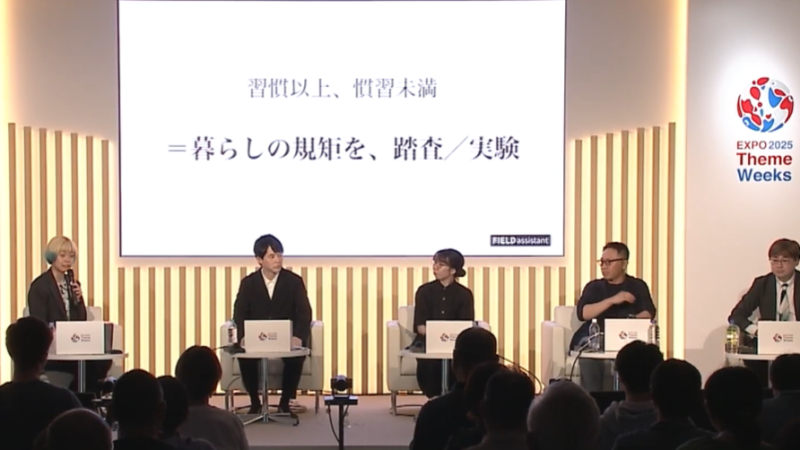
he emphasized the importance of practicing 'more than
habit, less than custom' to maintain mental health by
'familiarizing,' 'incorporating,' or
'dispelling' the 'sense of foreignness'
that mixes into relationships.
Keywords: Analog twin/Polar law/Team members/Sense of
foreignness/Habits and customs/Survival and clusters of
restraint/Sense of turning point/Comfort within
groups/Maintaining basics/Rules of living
This symposium provided an opportunity to consider the nature
of 'belonging' and 'mobility' in a
diversifying society, drawing on practitioners with advanced
approaches and perspectives. While examining the diverse
possibilities of community and mobility, we hope this serves
as a starting point for contemplating the future possibilities
for ourselves and the next generation, and thinking together.
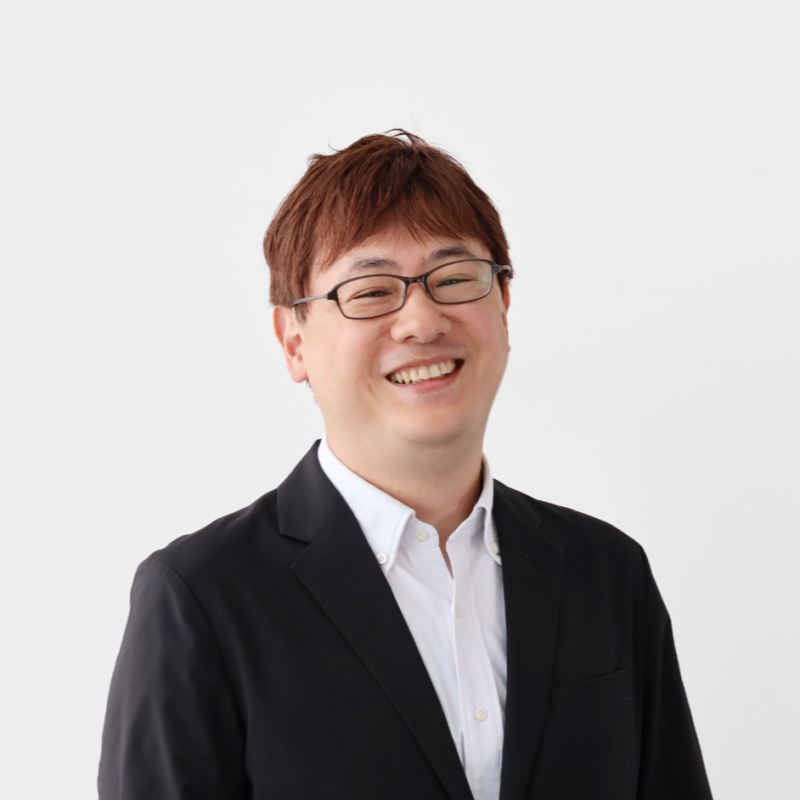
Cast
Moderator

Mineko Imanishi
Takenaka Corporation
Ph.D. in Human Sciences. Senior researcher at R&D Institute, Takenaka Corporation. Adjunct researcher at the Advanced Research Center for Human Sciences, Waseda University. Their research specialties include human behavior and pedestrian crowd flow. They also works extensively on the relationship between people and space.
View Profile
Close
close
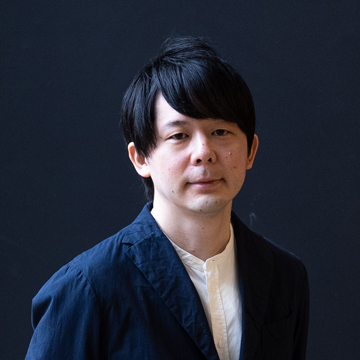
Tsukasa Ishizawa
Institute of Industrial Science, The University of Tokyo / Takenaka Corporation
Prof. Dr. Tsukasa Ishizawa serves as a Project
Associate Professor at the Institute of Industrial
Science, The University of Tokyo, where he seeks to
uncover the additional value of architectural data
generated throughout project processes. Tsukasa also
leads the Computational Design Group at Takenaka
Corporation, one of Japan's largest design-build
general contractors. His research has been widely
published, including notable works on BIM log mining
and the development of digital design tools. He has
made significant contributions to international
conferences and symposiums, sharing insights on the
potential of building information in construction and
emphasizing the importance of inclusive accessibility
to it.
In addition to his academic and professional
achievements, Tsukasa is a licensed first-class
architect, certified information technology engineer,
and an accredited professional for sustainability,
including LEED and CASBEE (Japan).
View Profile
Close
close
Speakers
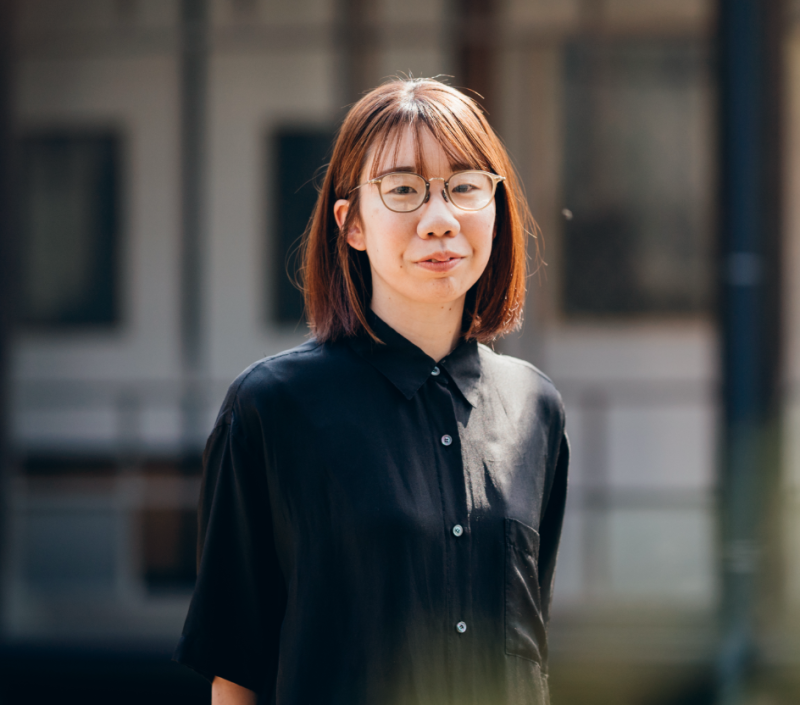
Saki Kondo
Sanchi-edit, Inc.
Born in Nara Prefecture, and currently resides in Shiojiri City, Nagano Prefecture. While managing a short-, medium-, and long-term stay facility in a town where traditional industry (Kiso lacquerware) has taken root, she is exploring how nature, history, and manufacturing culture can be combined with modern lifestyles and ways of living. She also participates in a project related to the promotion of immigration and settlement in Shiojiri City and the creation of district plans.
View Profile
Close
close
Yoshikazu Nango
Faculty of Engineering and Design, Hosei University
Born in Osaka in 1979. Sociology, architecture and
urbanism. Ph.D. in Interdisciplinary Information
Studies from the University of Tokyo.
He was a research associate and project lecturer at
the Interfaculty Initiative in Information Studies,
Graduate School of Interdisciplinary Information
Studies, the University of Tokyo, and a full-time
lecturer and associate professor at the School of
Information and Communication, Meiji University, and
then assumed the present post.
View Profile
Close
close

Yusuke Murakami
FIELD assistant
Extreme field architect / Representative of nonprofit organization FIELD assistant. He has been involved in many closed and isolated living conditions in search of a beautiful standard of living in the harsh environment known as the polar regions. He was a member of the wintering crew of the 50th Japan Antarctic Research Expedition (JARE) and also served as the executive officer of MARS160, an experimental life on Mars conducted in the Arctic. He has accumulated more than a thousand of days of experience living in polar regions.
View Profile
Close
close
The Future of Community and Mobility Week
Where will we live and with whom will we talk?:2050 scene
Agenda 2025 Co-created Programme
[Hypothesis of the Future in 2050]
A future where people can more flexibly select and fly around
places to live.
With the advancement of technologies and the transformation of
society, the meaning of mobility and place has changed and
diversified. What kind of world will expand in the future, and
what kind of desires will we realize? The panelists, who have
experimented with various lifestyles, will discuss scenes that
can be envisioned in the near future, 2050, interweaving the
perspectives of practitioners and people who live on.
-
2025.05.24[Sat]
14:00~16:00
(Venue Open 13:30)
- Theme Weeks Studio
OTHER PROGRAM
The Future of Community and Mobility Week