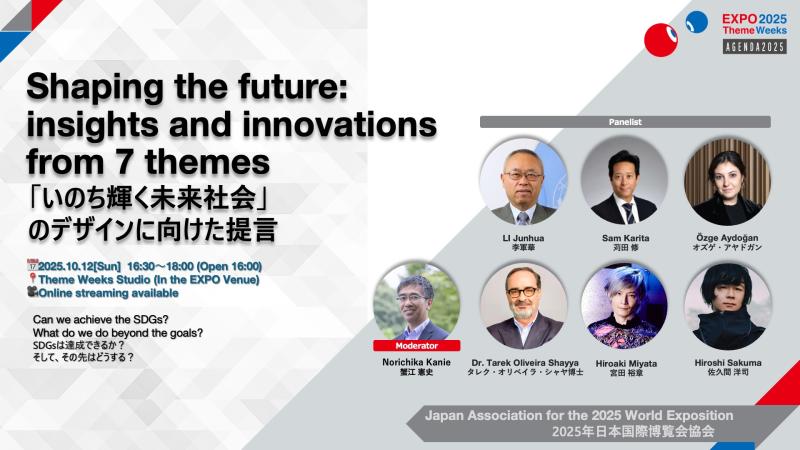
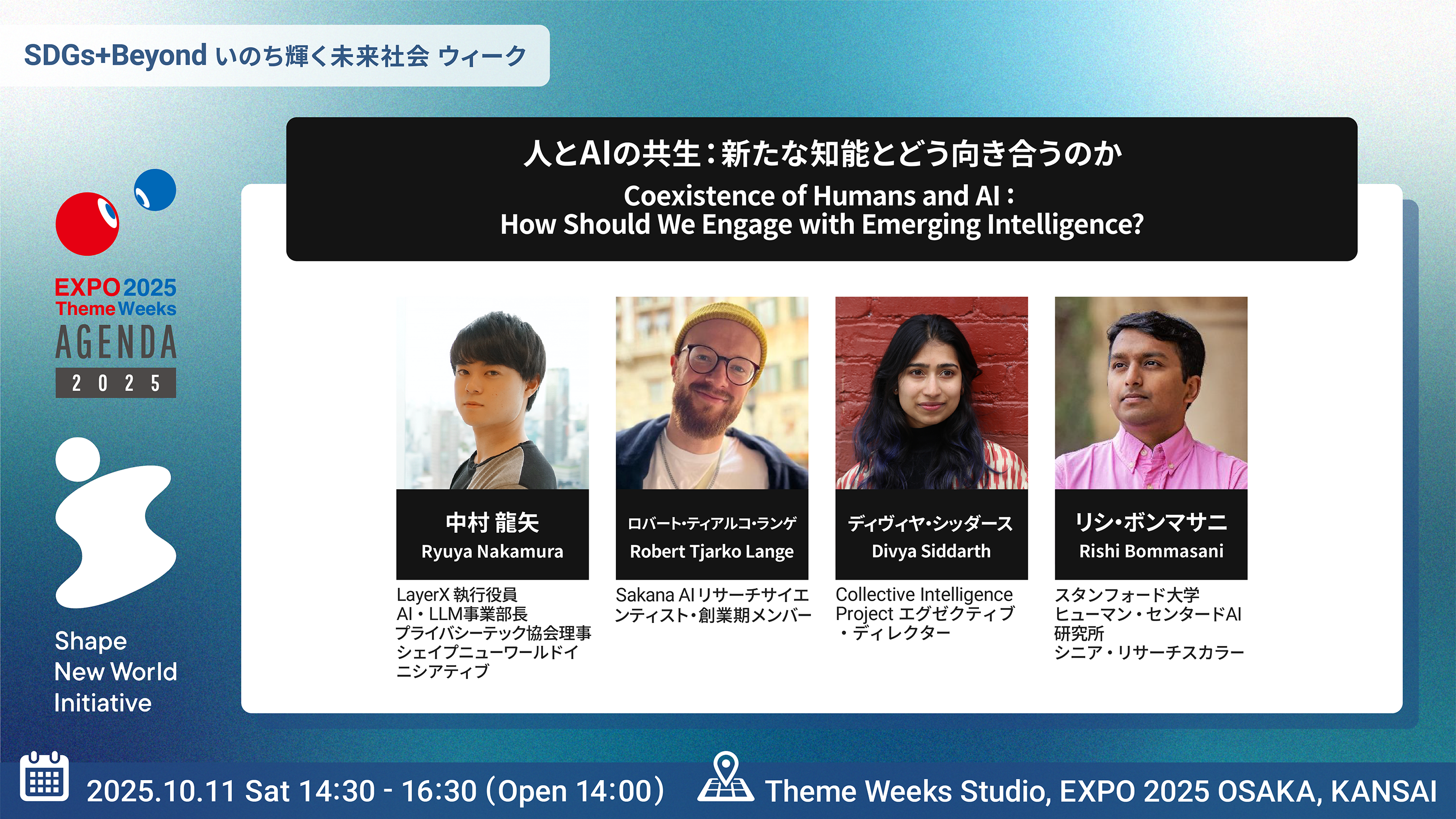
SDGs+Beyond Future Society for Life Week
Coexistence of Humans and AI: How Should We Engage with
Emerging Intelligence?
Agenda 2025 Co-created Programme
Shape New World Initiative
[A Hypothesis on the Future of 2050] AI surpassing human
capabilities in many domains will blur the boundaries
between AI and human society. While AI introduces various
risks, how can we ultimately create a world where human life
shines even brighter?
In this program, we will explore how we, as humans, should
engage with this new form of intelligence.
Recorded video available
Discussion
- future society
- AI #innovation
| Transmission of simultaneous interpretation | Provided |
|---|---|
| Language of interpretation | Japanese and English |
-

Agenda2025
Co-created Programme
-
Time and
Date of
the event -
-
2025.10.11[Sat]
14:30 ~ 16:30
(Venue Open 14:00)
-
- Venue
- Theme Weeks Studio
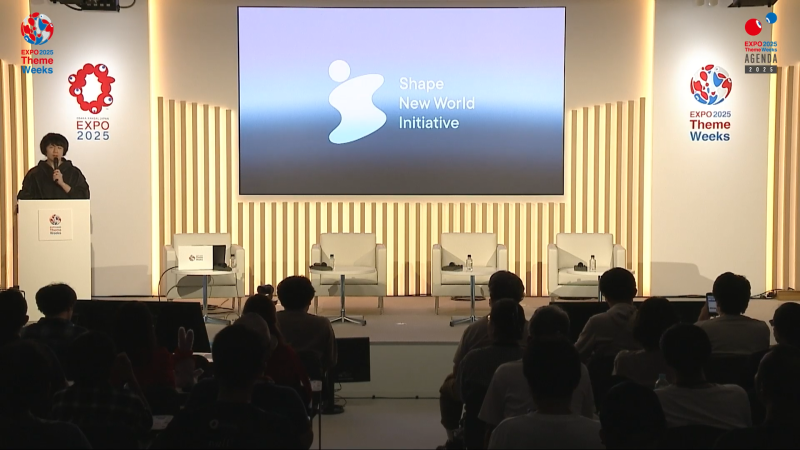


Programme details
*Subtitles: Choose “Subtitles/CC” in the “Settings” (gear
icon) at the bottom right of the YouTube video.
*Subtitles may not show with multiple languages or overlapping
audio.
In recent years, the emergence and rapid advancement of
generative AI and large language models have taken the world
by surprise. AI evolution is expected to significantly enhance
productivity and drive scientific progress, allowing humanity
to lead richer and more fulfilling lives. However, at the same
time, concerns are growing over potential risks such as AI
misuse leading to accidents, the militarization of AI, and
even the possibility of AI running out of control.
This program aims to explore how humans and AI can coexist and
move toward to "design future society for our
lives." To delve into this critical question, we have
invited three AI experts specializing in key areas such as
autonomous AI agents, AI safety, and AI alignment to discuss
the future of human-AI interaction.
Reports
【Reflection】
This session provided an opportunity to explore, from multiple
perspectives, how humans can coexist with rapidly evolving AI
technologies and shape the future of society and science. The
moderator invited participants to consider how AI development
may influence our ways of living and decision-making,
prompting discussions across ethics, creativity, and
democratic governance.
The session highlighted the possibility that, by 2050, a
significant proportion of research may be conducted either
autonomously by AI or collaboratively with AI systems. The
concept of an “AI scientist” capable of independently
generating hypotheses and drafting research papers was
introduced, illustrating how AI could accelerate scientific
exploration and creativity while humans assume roles in
supervision and verification. It was also emphasised that
broad trial and error, including failures, remains crucial to
scientific advancement, and that AI has the potential to
complement this process.
Attention was also given to the complexity of AI-related
risks. These range from technical imperfections, privacy
breaches, fraud, and child exploitation, to potential threats
such as cyberattacks or military applications. The session
highlighted that addressing these risks requires more than
technological solutions, emphasising the importance of
alignment with social systems and policy frameworks. At the
same time, the need for flexible policy design and the careful
use of societal simulations was underscored, in order to avoid
opportunity losses due to excessive regulation.
The session further examined the gap between the rapid
development of AI and society’s capacity for decision-making.
Practical examples were presented, including
citizen-participatory projects that demonstrate how AI and
human collaboration can support democratic decision-making.
The concept of “digital twins” was introduced to illustrate
how individual values and preferences could be represented in
AI systems. Such approaches offer the potential to enhance
social inclusion and expand citizen participation, with AI
serving as a supportive tool for democracy.
During the panel discussion, key themes included AI
transparency and openness, balancing regulation with
creativity, education for technical and policy professionals,
and ensuring opportunities for societal participation.
Overall, the session reinforced the idea that AI is not merely
a technological challenge, but a co-creative partner capable
of evolving with humans and contributing to society,
encouraging participants to actively engage with the
future.
【Post EXPO Initiatives】
Each speaker highlighted the following as key perspectives for
their respective research and business development after the
conference:
(1) Information Disclosure / Measuring Social Impact /
Establishing Democratic Governance
To enhance transparency and accountability in AI development,
promote the disclosure of model structures, training data, and
evaluation criteria, and advance the development of frameworks
for quantitatively measuring AI's social impact.
Furthermore, establish methods for democratically operating AI
in practical settings such as policy formulation, citizen
participation, and education, aiming for the “collective
intelligence utilization” of AI.
(2) Human Resource Development and Building Cross-Sectoral
Decision-Making Systems
Raise the baseline AI literacy of governments and companies
worldwide. Promote human resource development and
organizational building so that policymakers can understand AI
and appropriately utilize and regulate it. Particular emphasis
should be placed on designing a “hybrid decision-making
system” where cross-disciplinary experts and democratic
representatives collaborate.
(3) Building a Diverse AI Ecosystem / Expanding Experiential
Opportunities
To address biases and risks in AI, promote the coexistence of
diverse AI models independent of specific value systems.
Reflect differing needs across technologies, cultures, and
regions to build a truly diverse AI ecosystem. Furthermore, we
will develop a cultural foundation for coexistence by
expanding education, public dialogue, and experiential
opportunities, enabling citizens to correctly understand both
the benefits and risks of AI technology.
Through these efforts, we aim to establish AI as a
“co-creative partner that extends human intelligence” within
society, striving toward a sustainable future by 2050 where
technology and humanity mutually enhance each other.
*Part or all of this report was generated by AI.
Cast
Moderator
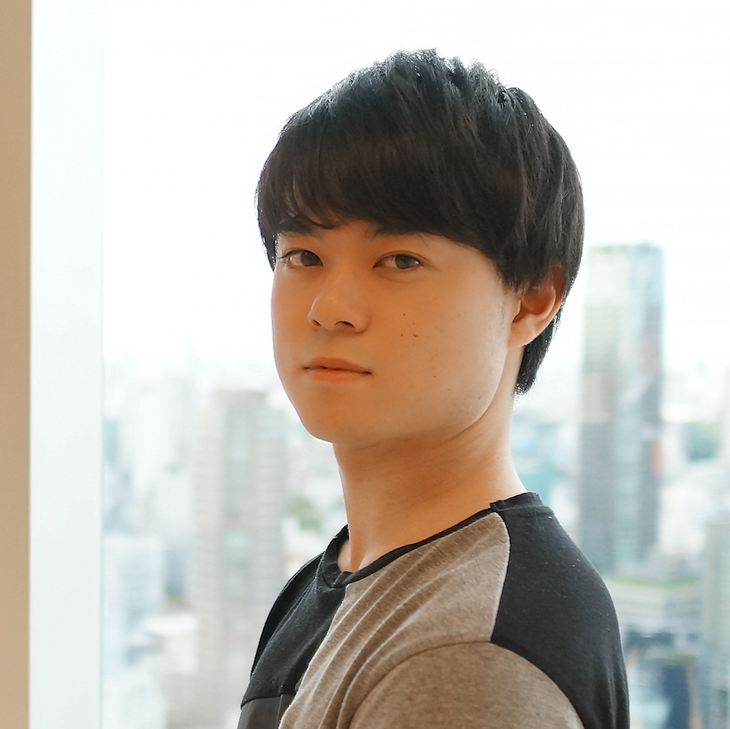
Ryuya Nakamura
Executive Officer & Head of Ai Workforce Division, LayerX / Director, Privacy Tech Association / Shape New World Initiative
After working as an engineer specializing in machine
learning and natural language processing, joined
LayerX as a founding member. Led the R&D division
before launching a new business utilizing
privacy-enchancing technologies. Previously active in
the public blockchain sector, discovering multiple
vulnerabilities in the Ethereum protocol and earning a
grant from the Ethereum Foundation as the first
Japan-based team.
Recognized as an IPA Unexplored Super Creator in 2020.
Named to Forbes JAPAN 30 UNDER 30 in 2023.
View Profile
Close
close
Speakers

Robert Tjarko Lange
Research Scientist and founding member, Sakana AI
Robert Tjarko Lange is a Research Scientist and founding member at Sakana AI where he builds nature-inspired methods for the Large Language Model era. More specifically, he works on leveraging foundation models to augment and automate the scientific discovery process (e.g. the AI Scientist). Previously, he worked at Google DeepMind with the Tokyo team as a full-time student researcher and interned at Legacy DeepMind (Discovery team) as well as Accenture. Furthermore, he is a final year PhD student working on Evolutionary Meta-Learning at the Technical University Berlin. He completed a MSc in Computing at Imperial College London, a Data Science MSc at Universitat Pompeu Fabra, and an Economics undergraduate at University of Cologne.
View Profile
Close
close

Divya Siddarth
Executive Director, the Collective Intelligence Project
Divya Siddarth is the founder and executive director of the Collective Intelligence Project, which works to democratize artificial intelligence. CIP has worked with partners such as the Taiwanese Digital Ministry, the UK Frontier AI Task Force, OpenAI, Anthropic, Mistral, and Creative Commons to apply new governance models to AI, and build AI-enabled platforms for the future of democracy. For this work, she was recently named one of the TIME 100 Most Influential People in AI. She has held positions at the UK AI Safety Institute, Microsoft's Office of the CTO, and the Oxford Internet Institute.
View Profile
Close
close
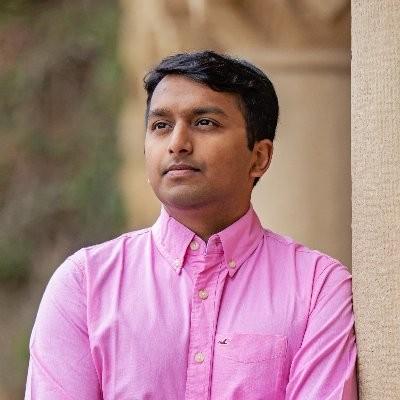
Rishi Bommasani
Senior Research Scholar, Stanford Institute for Human-Centered Artificial Intelligence
Rishi Bommasani is a senior research scholar at Stanford HAI. His research studies the macroscopic societal and economic impacts of AI. His work advances evidence-based public policy in California, the European Union, the United States, and at the international level. His work has been recognized by multiple best paper awards at top AI venues as well as publication in the New York Times, Wall Street Journal, Nature, and Science. He received his PhD from Stanford Computer Science, his masters from Cornell Computer Science, and his undergrad from Cornell Math and Cornell Computer Science.
View Profile
Close
close
SDGs+Beyond Future Society for Life Week
Coexistence of Humans and AI: How Should We Engage with Emerging
Intelligence?
Agenda 2025 Co-created Programme
[A Hypothesis on the Future of 2050] AI surpassing human
capabilities in many domains will blur the boundaries between
AI and human society. While AI introduces various risks, how
can we ultimately create a world where human life shines even
brighter?
In this program, we will explore how we, as humans, should
engage with this new form of intelligence.
-
2025.10.11[Sat]
14:30~16:30
(Venue Open 14:00)
- Theme Weeks Studio
OTHER PROGRAM
SDGs+Beyond Future Society for Life Week