SDGs+Beyond Future Society for Life Week
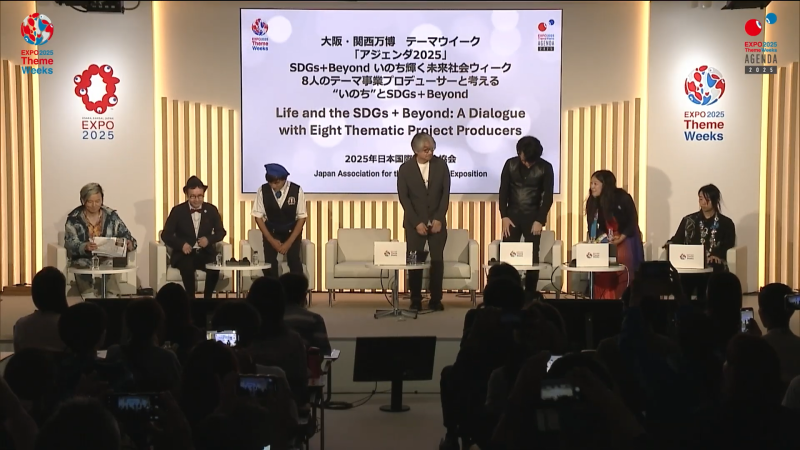
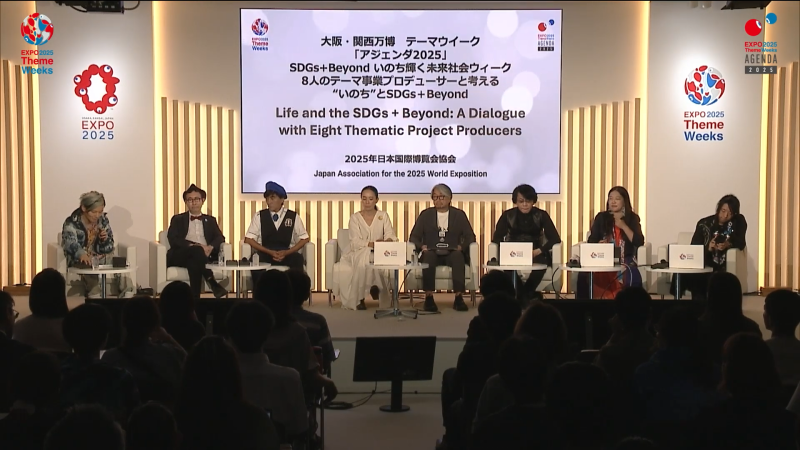
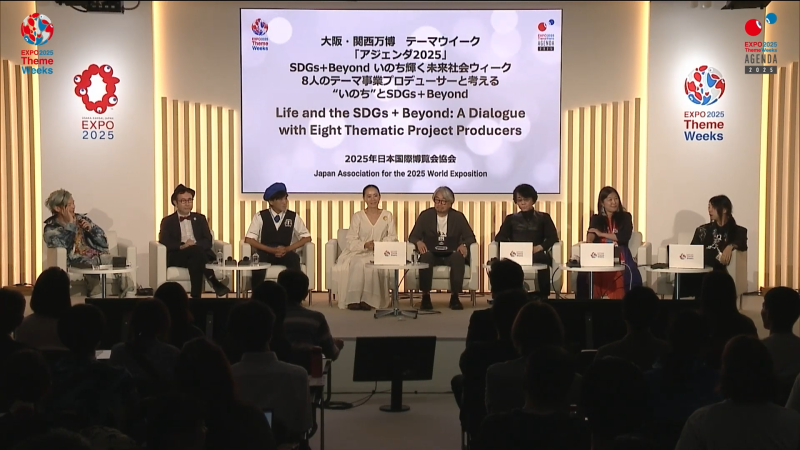
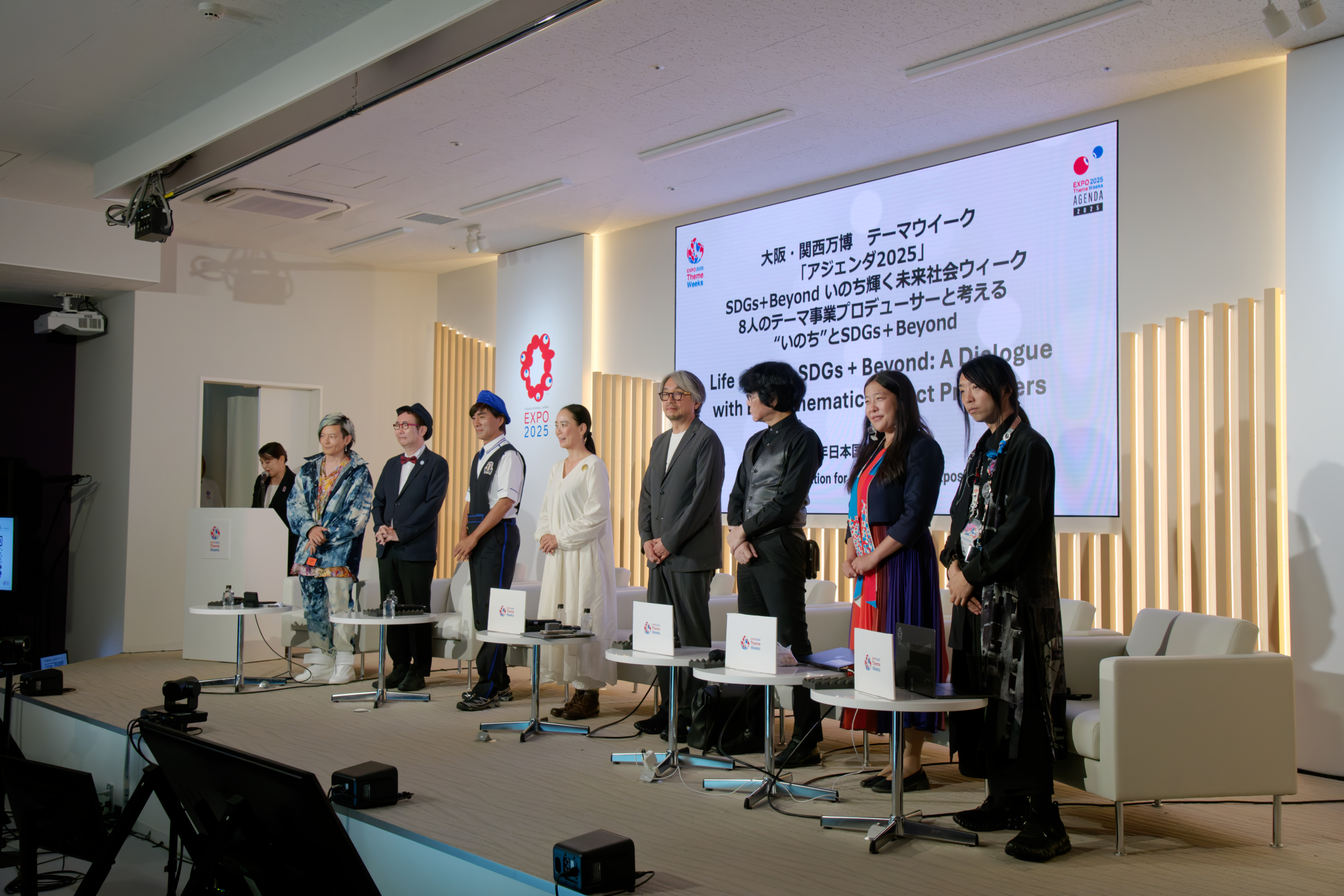
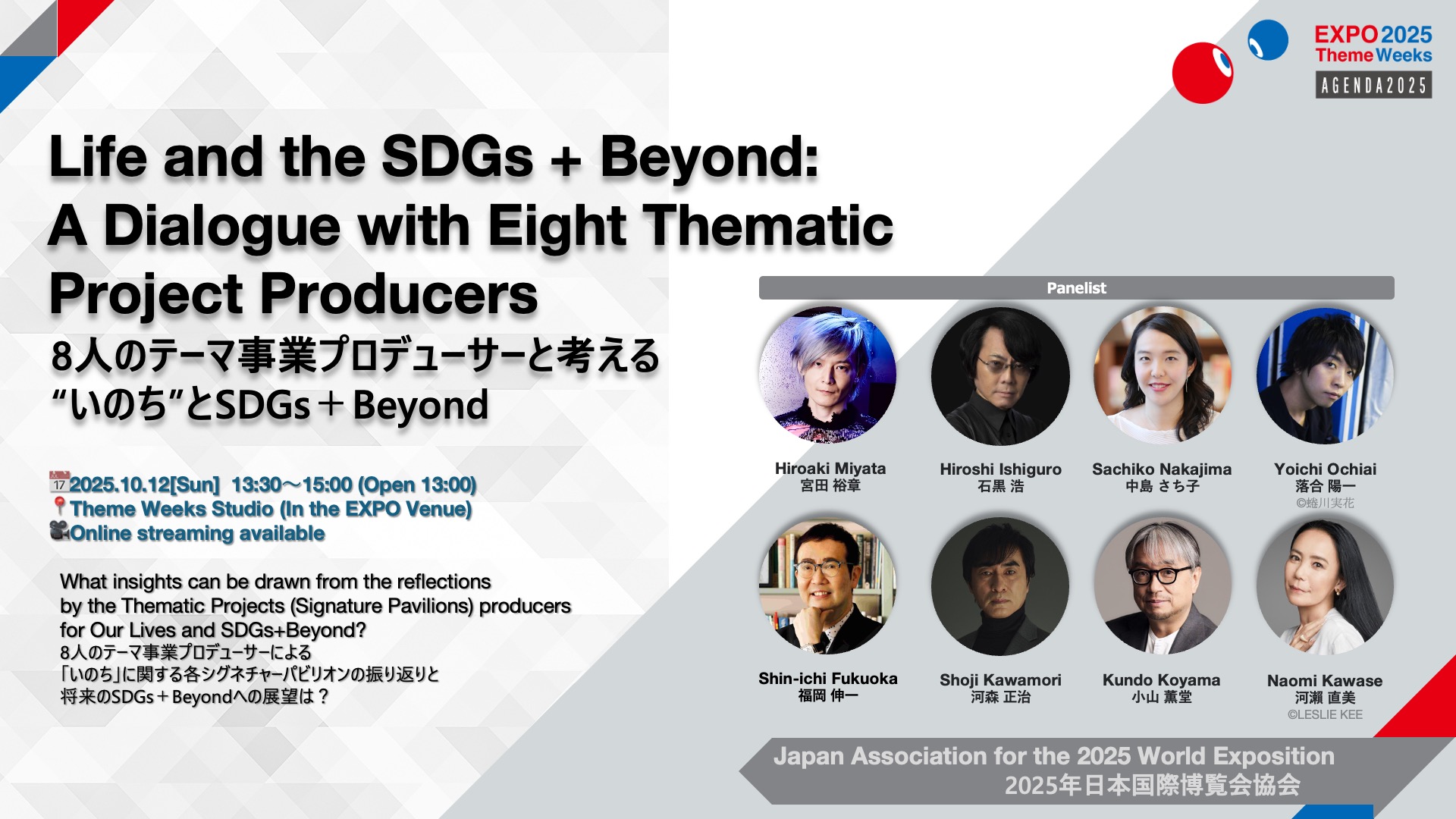
Life and the SDGs + Beyond: A Dialogue with Eight Thematic Project Producers
Japan Association for the 2025 World Exposition
The programme, together with the General Sponsors, explores: 'What insights can be drawn from the reflections by the Thematic Projects (Signature Pavilions) producers for Our Lives and SDGs+Beyond?'
Recorded video available
Discussion
- Others
| Transmission of simultaneous interpretation | Provided |
|---|---|
| Language of interpretation | Japanese and English |
-

Agenda2025
Organised Programme
-
Time and
Date of
the event -
-
2025.10.12[Sun]
13:30 ~ 15:00
(Venue Open 13:00)
-
- Venue
- Theme Weeks Studio
Programme details
*Subtitles: Choose “Subtitles/CC” in the “Settings” (gear
icon) at the bottom right of the YouTube video.
*Subtitles may not show with multiple languages or overlapping
audio.
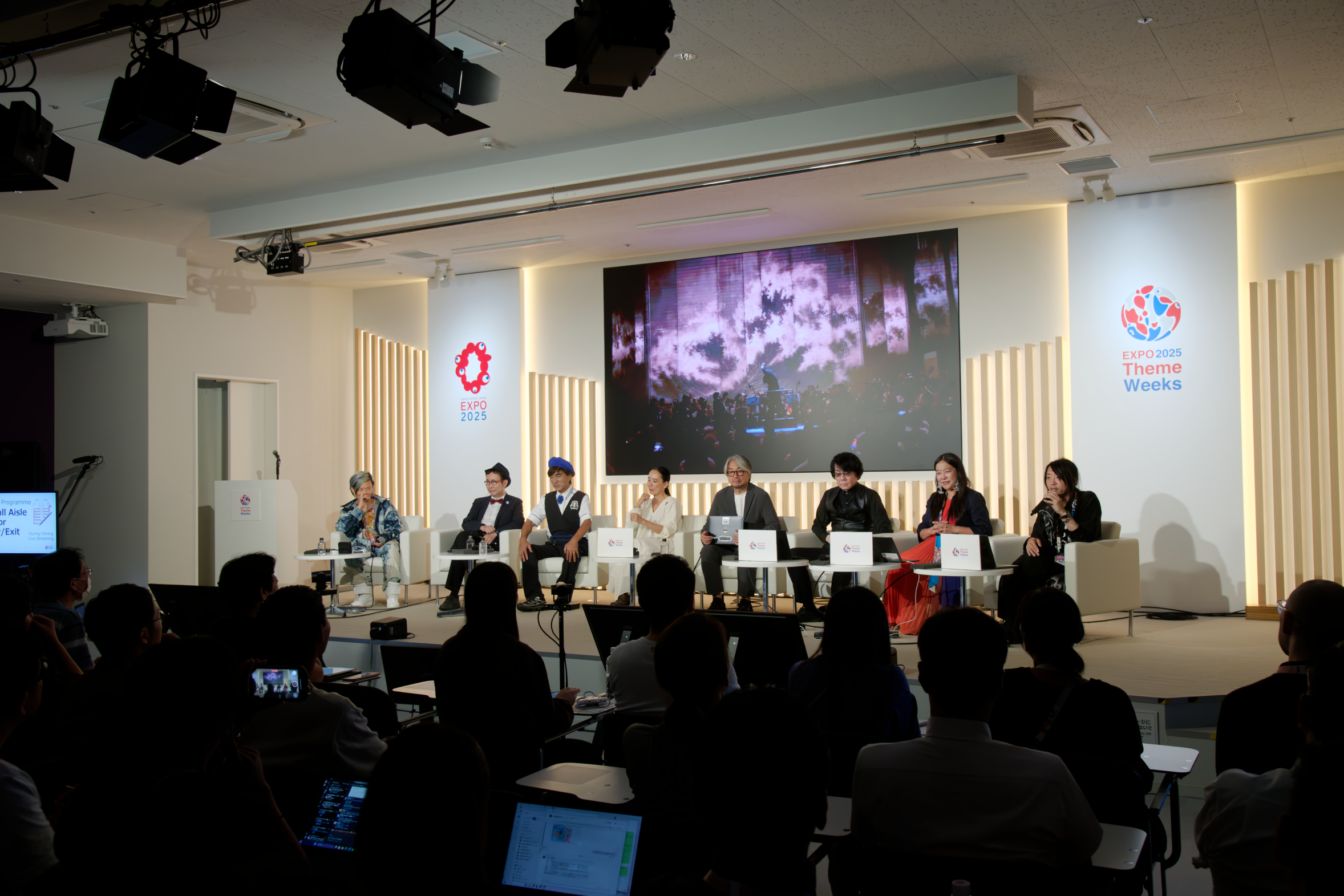
The concluding highlight of Expo 2025 Osaka, Kansai’s Theme
Weeks will be a special 90-minute panel discussion featuring
all eight Theme Project Producers.
Since the earliest stages of preparation, Expo 2025 has been
guided by a fundamental question: “What is life?”
Each Producer has explored this profound inquiry through their
Signature Pavilion, addressing it from different
perspectives—ranging from science and technology to culture,
society, and the environment.
In this culminating session, the Producers will come together
to reflect on their journeys, share insights from their
creative challenges, and reveal how their visions connect to
the future of humanity. More than a retrospective, this
dialogue will open the central question of “life” toward the
future: How can it shape the design of our societies? What
challenges must we embrace and pass on to the next
generation?
This 90-minute finale will reimagine the vision of a “Future
Society for Our Lives” that Expo 2025 aspires to co-create,
and serve as a new starting point for collaboration.
As the culmination of the Osaka, Kansai Expo Theme Weeks—and
as a dialogue that opens the door to the future—we warmly
invite you to join us.
Reports
【Program Summary】
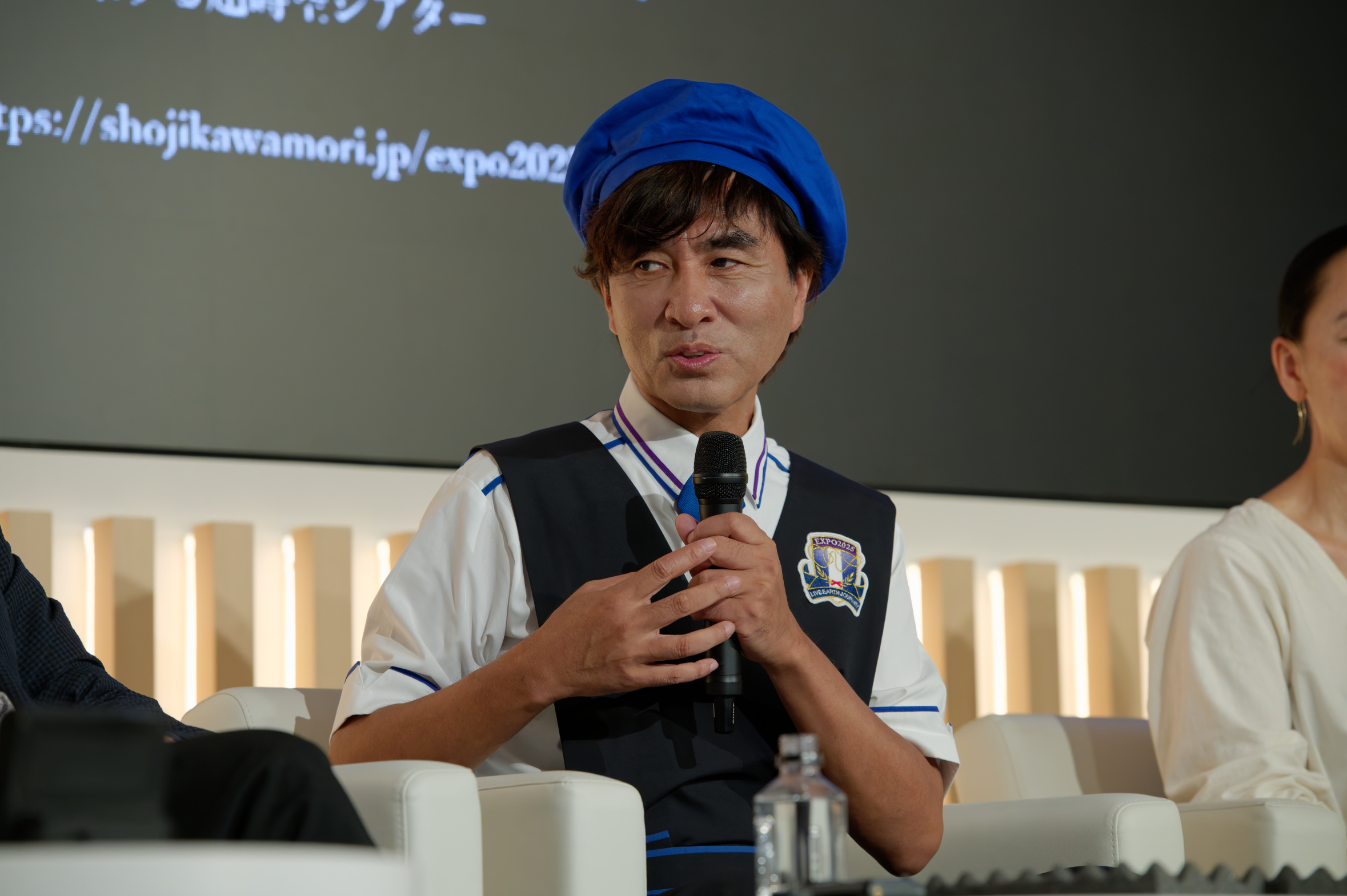
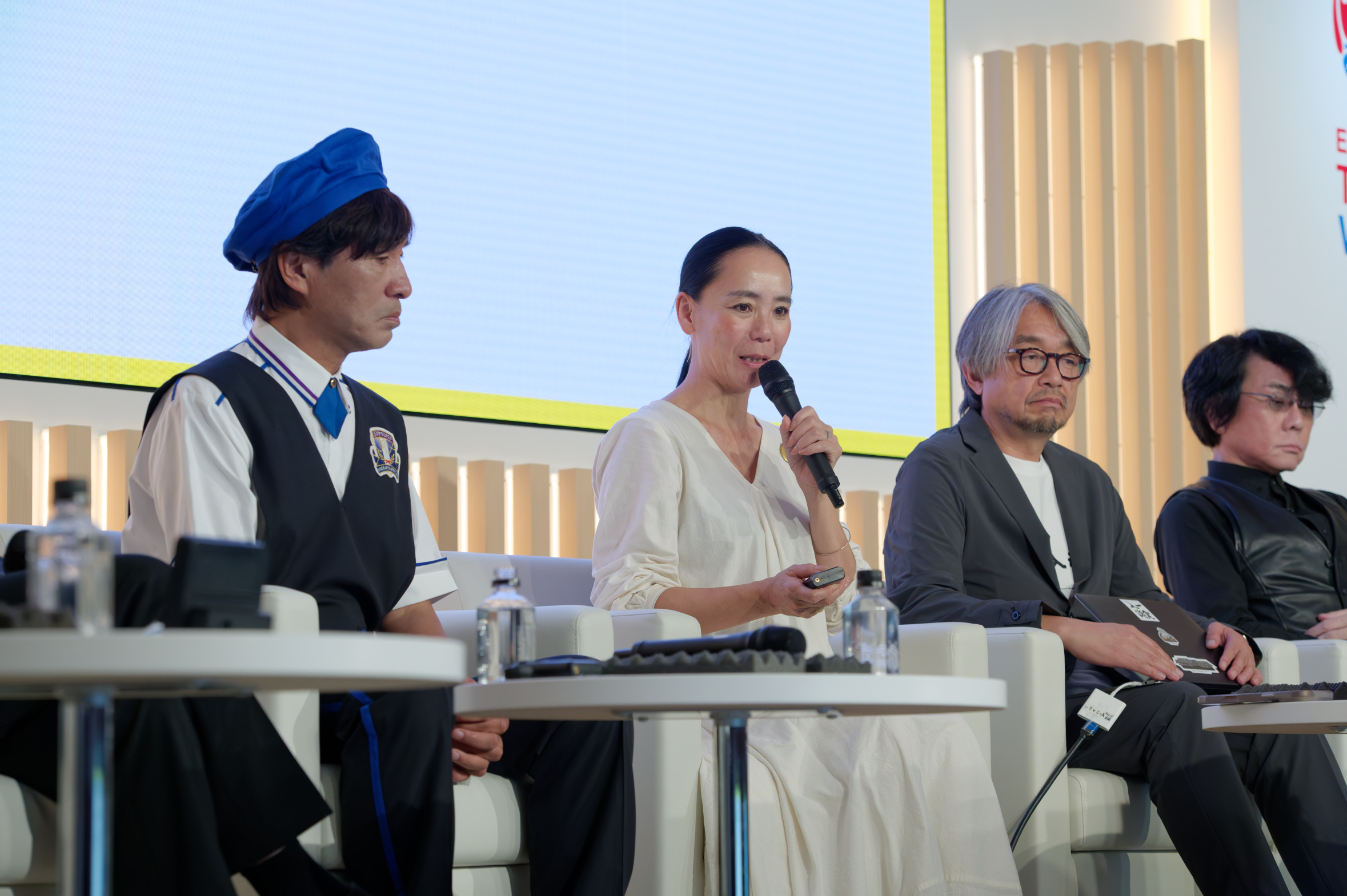
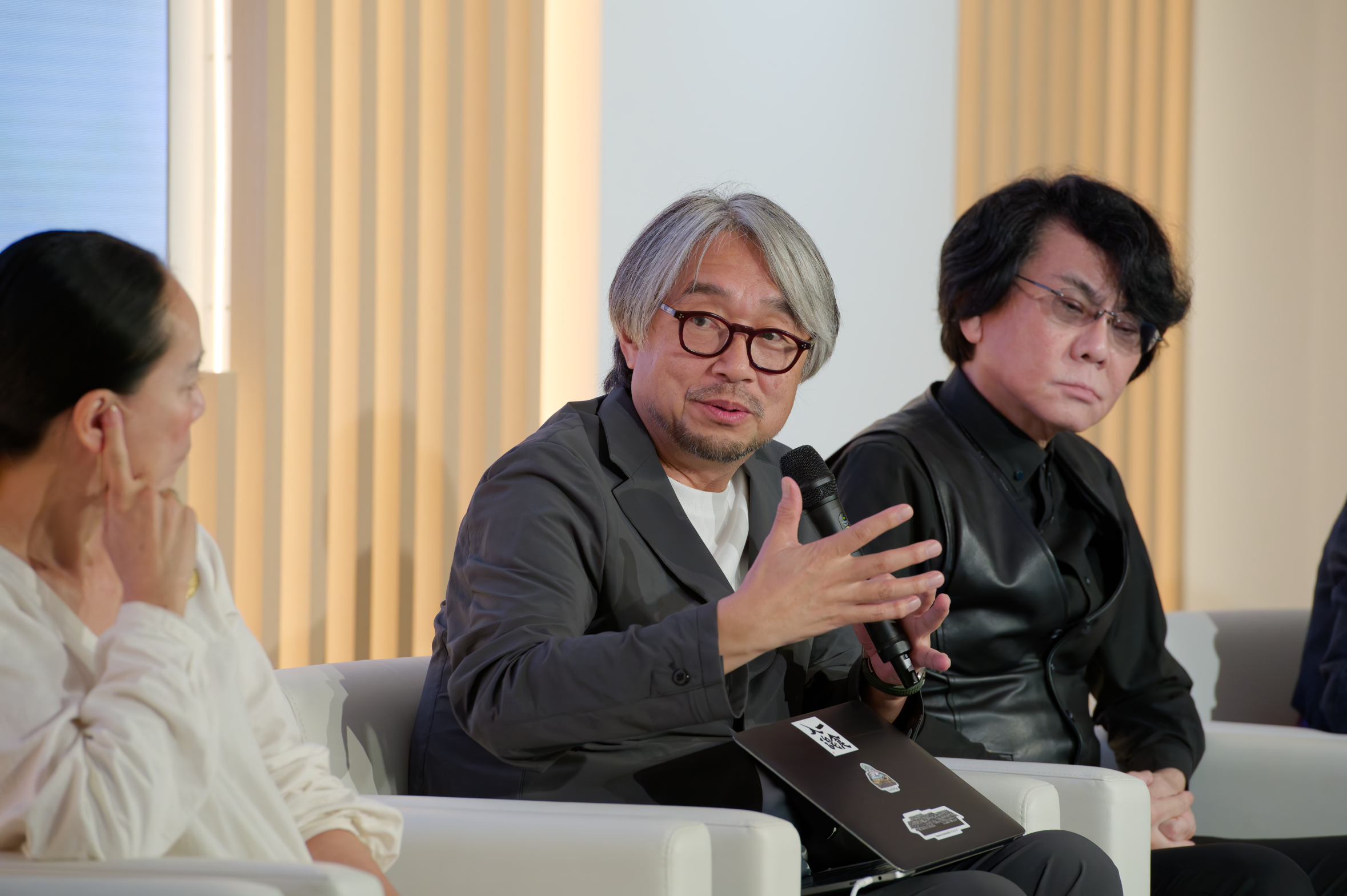
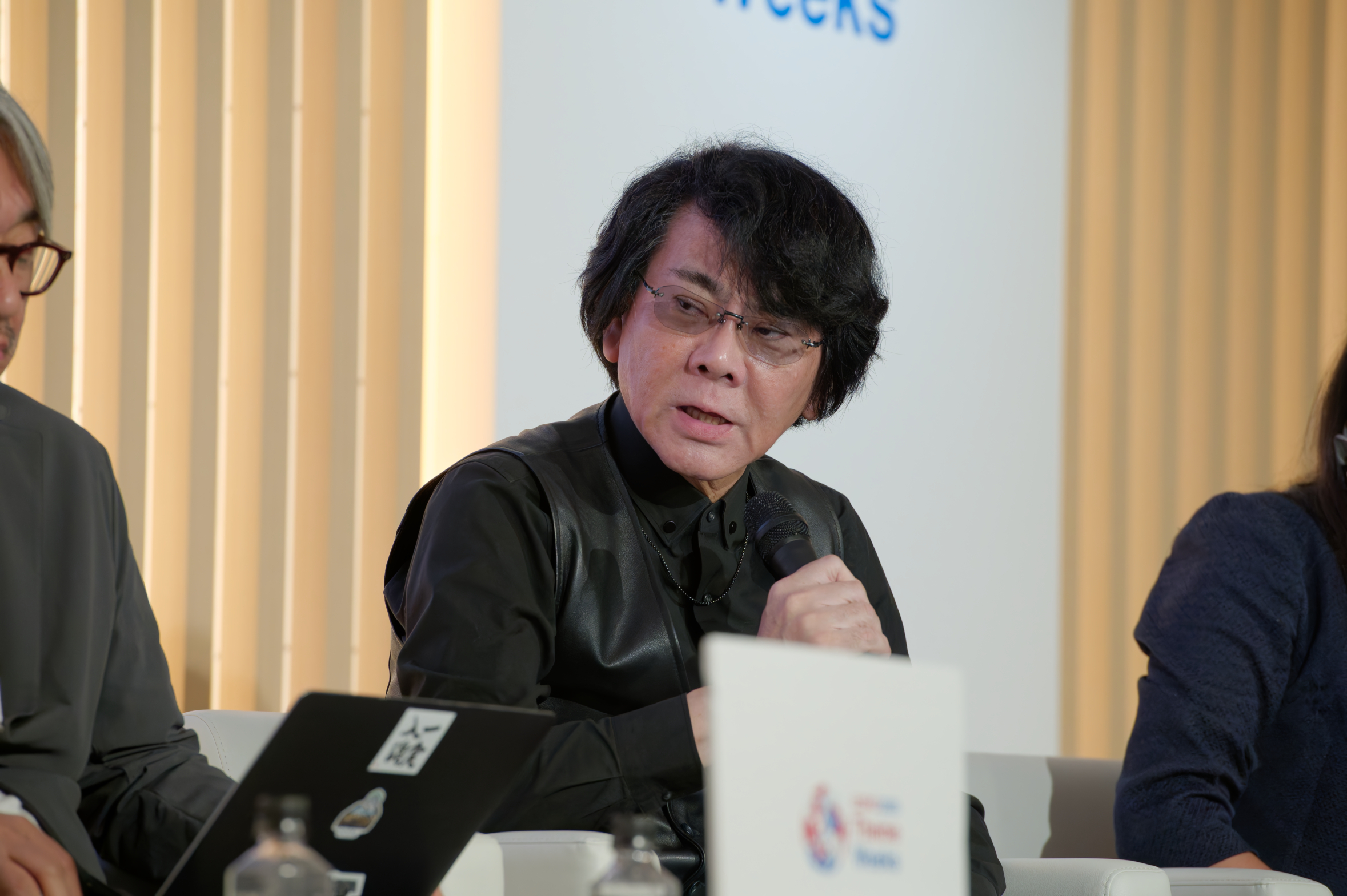
This session brought together eight Theme Project
Producers—each representing the vision of “Designing Future
Society for Our Lives,” the core theme of Expo 2025 Osaka,
Kansai. The producers reflected on the achievements of their
respective Signature Pavilions, sharing diverse perspectives
on “Life” that emerged through the Expo and discussing
possibilities that extend beyond the SDGs. Each speaker, from
the fields of science, art, architecture, media, education,
and technology, explored life from a unique angle, presenting
creative visions for a sustainable—and more importantly,
regenerative—future.
【Speaker Summary: Hiroaki Miyata】
Professor Hiroaki Miyata, who oversaw the entire program,
emphasized the significance of bringing together eight
Thematic Project Producers, each presenting their own unique
worldview and philosophy on the theme of “Life.” For Miyata,
Expo 2025 is not merely an exhibition or showcase, but a
living process—a platform for dialogue where human imagination
and the potential of society intersect to co-create the
future.
At the outset, he noted that having all eight producers
gathered in one forum was an exceptionally rare opportunity.
Through the fusion of their distinct personalities and areas
of expertise, a multi-layered vision emerged—one that
transcended the conventional model of the Expo as a single,
unified narrative or fixed vision of the future. Each
producer’s thematic pavilion illuminated the universal theme
of “life” from a different dimension—science, art, philosophy,
ethics, and technology. The very act of these diverse
perspectives colliding and resonating with one another, he
said, embodied the essence of the “Designing Future Society
for Our Lives” vision that the Osaka–Kansai Expo aims to
realize.
Reflecting on the six-month Expo, Miyata remarked that beyond
visitor numbers and satisfaction levels, what mattered most
was the increase in visitors who continued to ask questions.
Each pavilion functioned not as a place to provide answers,
but as an instrument to share fundamental questions such as
“Why?” and “How should we live?” He stressed that “the Expo is
no longer something to observe—it has become an experience of
thinking together.” This transformation, he argued, marks a
shift from achieving the “goals” of the SDGs toward a new
phase—Beyond—in which people reconstruct their own values and
collaboratively create futures that extend beyond predefined
objectives.
Miyata also referred to the organic connection between the
Theme Weeks and the main Expo exhibitions. By interlinking
national pavilions, civic events, and academic sessions, the
Expo cultivated a network of resonating fragments of
knowledge. In this sense, the Expo was not a collection of
displays, but rather a co-creative arena that united wisdom
from across the world.
In conclusion, Miyata stated that “the future is not singular,
but plural—Futures.” This idea rejects a top-down,
technocratic utopia and instead affirms a plurality of futures
in which diverse cultures, ideas, and forms of life each weave
their own rhythms. For him, a “Future Society for Our Lives”
is not a completed ideal, but a society that values the very
process of resonance, co-creation, and becoming.
Miyata’s reflections encapsulated the transformation of the
Expo from a place that provides answers into a place that
continuously shares questions, perfectly embodying the spirit
and philosophy of SDGs + Beyond.
【Speaker Summary: Shin-ichi Fukuoka】
Biologist Shin-ichi Fukuoka presented, through his Signature
Pavilion “Dynamic Equilibrium of Life,” the essence of life
not as a history of “struggle,” but as a continuous chain of
“symbiosis” and “altruism.” Although there were initially
skeptical voices about the Expo, he reflected that over time,
many visitors returned multiple times, transforming the site
into a place where people could personally experience the
meaning of “life.” In particular, he cited the phenomenon in
which a massive emergence of midges was followed by the
arrival of dragonflies, swallows, and bats, restoring
ecological balance without human intervention. He described
this as a “live demonstration of life’s dynamic equilibrium,”
an opportunity for people to feel the self-regulating power of
nature beyond human control.
At the core of the pavilion lies the concept of Dynamic
Equilibrium—the idea that life is not a fixed structure but is
sustained through an ever-changing flow of molecules,
embodying stability through constant transformation. Fukuoka
rejected the traditional view of evolution as a “history of
competition,” redefining it instead as a “history of
coexistence and altruism.” He warned that when human society
forgets this principle of life, sustainability itself is lost.
From the perspective of SDGs + Beyond, Fukuoka pointed out
that “humans alone have created an unsustainable world.” While
all living systems function through flow—continuously passing
resources to others rather than storing excess—human
civilization has built systems of stock, accumulating and
dividing rather than sharing. True sustainability, he argued,
lies in maintaining circulation and mutual sharing, as life
itself does.
He also compared the axis-based structure of Expo 1970 to Expo
2025’s Grand Roof Ring, describing the latter as a “cell
membrane”—a permeable, oscillating space that connects the
inside and the outside. Human society, too, he argued, must
evolve into a flexible network of mutual influence, rather
than a closed and rigid order. He further criticized the
modern “job description–based” organizational model and urged
that society learn from the stem cell–like flexibility of
living systems—structures that adapt their roles to changing
circumstances and support one another cooperatively.
Finally, Fukuoka stated that “life is not designed; it
emerges.” He concluded that instead of relying on excessive
control and planning, humanity should find order within
fluctuation and generation itself. Returning to the principles
of life—coexistence, reciprocity, and circulation—he affirmed,
is at the very core of SDGs + Beyond.
【Speaker Summary: Shoji Kawamori】
Director and mechanical designer Shoji Kawamori presented his
Signature Pavilion “Adventure of Life,” built around the theme
of the continuous “chain reaction” in which life connects,
encounters, and transforms. He explained that he sought to
express life not as something consumed in a linear process,
but as an ongoing “process of fusion and transformation” that
arises through mutual interaction among living beings.
At the heart of the exhibition was an immersive experience
that allowed visitors to perceive the world from the
perspectives of other living beings—fish, birds, and
microorganisms. Kawamori invited visitors to imagine that when
humans eat fish, they are “merging with the fish to become a
new living being.” Through this, he redefined the act of
“eating life” not as domination but as symbiosis, encouraging
a shift away from an anthropocentric worldview.
He also stated that “life is an infinite chain reaction,”
extending this concept to intellectual and emotional exchange
as well. Reading, he explained, is one such form of fusion and
transformation—when we internalize another person’s thoughts
and merge them with our own, we are participating in a living
chain of ideas. The exhibition was designed to enable visitors
to feel physical and emotional changes as they connected with
nature, others, and society, ultimately allowing them to
realize that “the brilliance of life lies in its continual
transformation.”
Kawamori’s remarks intertwined his creative imagination with a
profound philosophy of life. The recurring motif of “fusion
and transformation,” which has long characterized his
animation works, was reinterpreted here as a philosophy of
living beyond the realm of entertainment. From the cosmos and
sunlight to air, water, and microorganisms in the soil, all
existences continuously interact and transform themselves.
Within that endless cycle, he said, lies the universality of
life.
He further noted that while social life requires adherence to
individual rules, we are all living beings participating in an
infinite chain of existence. He called for renewed awareness
of humanity’s connection with other forms of life. Through
film, sound, and spatial design, his pavilion embodied this
philosophy, offering visitors an experiential sense of
vitality and circulation.
Kawamori’s work transcended the boundaries of science and art,
providing an experiential symbiosis through the senses that
inspired many visitors to recognize that “they too are part of
nature.” In his words, “the brilliance of life” is precisely
the continuous process of transformation through resonance
with other lives.
【Speaker Summary: Naomi Kawase】
Film director Naomi Kawase presented the concept of “Dialogue
Theater – Testimony of Life” as an experimental space that
reveals divisions existing throughout the world and seeks to
address them through dialogue. Instead of showcasing exhibits,
this theater holds nine intimate dialogue sessions per day,
where people face each other directly and connect heart to
heart in one-time-only encounters.
In each session, a visitor is randomly paired with one of 99
“speakers” to engage in a ten-minute conversation. The
dialogue ends abruptly at the ten-minute mark, but the
experience continues within each participant—who carries
forward the realization that life can change depending on
one’s state of mind. Kawase expressed her wish that
participants would take home the feeling of “finding me within
you, and you within me.”
She also hosted several special dialogues. One session on
April 21 focused on a film about women from Palestine and
Israel, during which the invited Israeli director and her
mother shared the moving statement: “The color of the tears we
shed is the same.” Another memorable session invited a war
photographer from Kyiv, Ukraine, to speak in Nagasaki on the
anniversary of the atomic bombing; he expressed his desire “to
let go of the hatred that gives rise to conflict.” On April
25, a terminally ill couple engaged in a dialogue in which the
husband said, “The final day continues forever—it never truly
ends,” and he passed away 60 hours later.
Kawase stated her wish to carry forward the “recreation of
life through dialogue” as a legacy for the future. Over the
course of the exhibition, more than 1,600 dialogues took place
in the theater. All of them were recorded on video and are
being archived. Kawase explained that her intention was to
create a “pavilion without answers”—entrusting each visitor
with the task of continuing the story in their own hearts.
Her message serves as a profound contribution to the Expo’s
broader discourse on peace and human rights, standing out
among the eight thematic projects as one that directly engages
with the very core of these universal values.
【Speaker Summary: Kundo Koyama】
Writer and producer Kundo Koyama, in his pavilion “EARTH
MART,” explored the theme of reexamining “life” through the
lens of “food.” At the beginning of his presentation, he
recited his own poem titled “Life,” declaring, “To be able to
eat is to keep other lives alive,” and “‘Itadakimasu’ is a
word of gratitude, while ‘Gochisousama’ is a vow to live for
tomorrow.” Through these words, he invited visitors to
reconsider the ethical and spiritual significance of eating.
The pavilion was designed in the style of a supermarket,
visually depicting, for example, the approximately 28,000 eggs
a person consumes in a lifetime, as well as exhibits that
allow visitors to feel the lives of fish, vegetables, and
animals. These installations were intended to pose the
question: “How many other lives do we receive in order to
sustain one human life?” Moreover, by displaying photographs
of dining tables from around the world, highlighting cultural
and economic disparities, the pavilion encouraged visitors to
reflect on “what it means to eat.” It offered a perspective
that “to eat is to live together, gathered around the dining
table of the Earth.”
Through these exhibits, Koyama hoped that visitors would
experience “the happiness of eating,” and that saying
“Itadakimasu” three times a day would serve as a “switch of
gratitude,” inspiring mindfulness toward others and
rediscovering the power of words. Visitors shared impressions
such as “It made me feel kind,” which Koyama interpreted as
evidence that the pavilion became “a place to reconsider
self-centered thinking through the act of eating.”
As for his thoughts on the concept of “SDGs + Beyond,” Koyama
stated that it should not simply mean “going beyond the SDGs,”
but rather creating new systems. As one idea, he proposed
introducing and sharing words or concepts from different
countries and Japanese dialects that are little known
elsewhere—publishing a new selection each year by country or
region—to expand mutual understanding.
In conclusion, Koyama emphasized that what truly matters is
how often we can recall the realizations gained at this Expo
in our daily lives. He explained that our way of seeing and
feeling changes through our “heart” and “gaze,” and that
approaching people, nature, and the planet with a kind heart
is, in itself, the essence of the SDGs. Finally, he stated
that for people with different values to connect, it is vital
to share emotional experiences such as “deliciousness” and
“beauty”—moments that move the heart together—and that culture
and the arts are indispensable for making such shared
experiences possible.
【Speaker Summary: Hiroshi Ishiguro】
Roboticist Hiroshi Ishiguro used his Signature Pavilion “The
Future of Life” to reexamine the relationship between humans
and technology. He explored fundamental questions: “What is
life?” and “What distinguishes humans from
machines?”—approaching them at the intersection of science and
philosophy.
At the center of the exhibition was a short film depicting a
story between a grandmother and her grandson. After the
grandmother’s death, the grandson struggles with whether to
transfer her memories and personality into an android. The
work invited visitors to ponder whether storing human memory
in AI constitutes an extension of life or the birth of a new
being.
Through this narrative, Ishiguro raised ethical and
existential questions about how far technology can recreate
life. Post-exhibit surveys showed that only about 25% of
visitors said they would want to “become an android,” but
nearly half supported the idea of preserving the memory of a
loved one. “The division of opinions itself is meaningful,”
Ishiguro emphasized, “because 93% of visitors said the
experience made them think about the meaning of life.”
He argued that as AI and robotics advance, humanity must
redefine what it means to be human. Abilities once considered
uniquely human—emotion, empathy, connection—are now
increasingly replicable by technology. Therefore, this is the
moment for humanity to reflect on its own awareness of
existence. “We need not fear technology,” he said. “Instead,
we should use it as a mirror to better understand ourselves.”
In the context of SDGs + Beyond, Ishiguro stressed the
importance of co-evolution between humans and technology.
Technology should not merely be a tool for solving problems
but a partner that expands human potential and fosters new
ethics and values. As AI and robotics inevitably evolve,
society must reconstruct a human-centered understanding of
technology.
He concluded by saying that the future should not be feared
but shaped through dialogue between humanity and its
creations. For Ishiguro, the brilliance of life lies in that
evolving relationship—where the human and the artificial
reflect and transform one another.
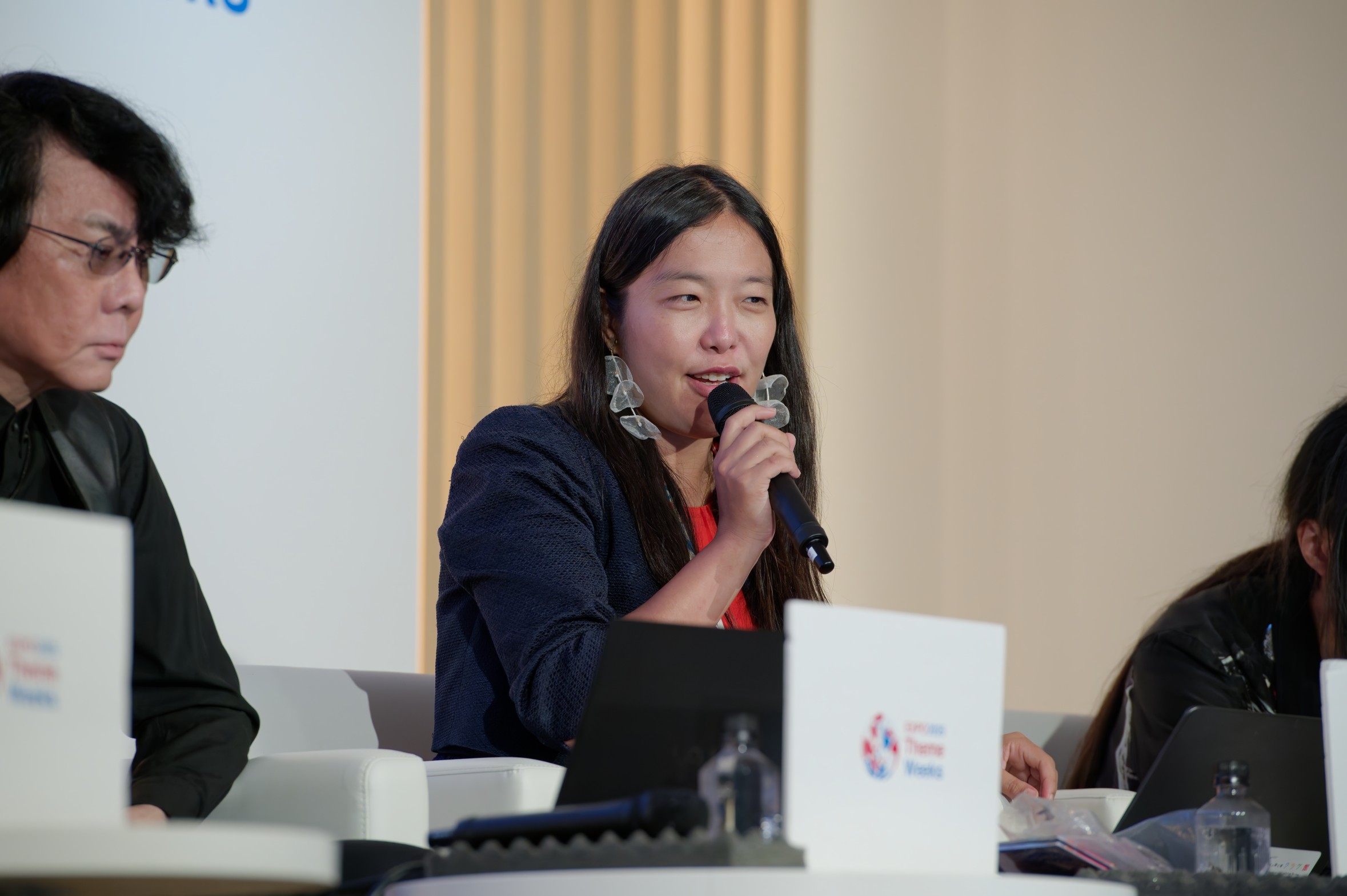
【Speaker Summary: Sachiko Nakajima】
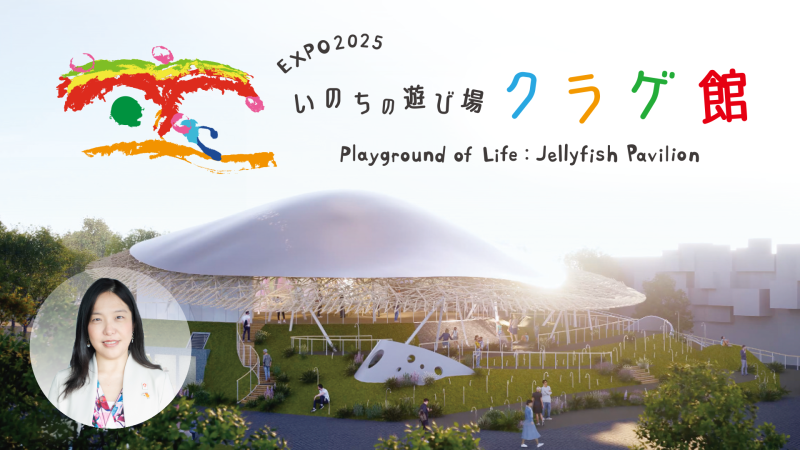
Musician and mathematician Sachiko Nakajima, through her
pavilion “Jellyfish Pavilion – Playground of Life.” embodied
the concept of “democratizing creativity across diverse forms
of life.” Her vision was to create a society where everyone
can access the joy of creation—one that transcends boundaries
of disability, nationality, age, and social position,
recognizing the mere act of existence itself as a source of
value. Nakajima emphasized that “creativity is not a special
talent, but a diverse power inherent in all forms of life,”
and that the mission of this pavilion was to create a space to
draw out that creative potential.
The Jellyfish Pavilion was an experiential playground that
transformed through light, sound, and motion—as if the entire
space were breathing. Explaining why she chose the jellyfish
as its symbol, Nakajima said she was inspired by the “playful
fluctuation” essential to both life and creativity. The
jellyfish, with its transparent body, transcends the fixed
sense of self and drifts harmoniously with other beings. It
represents “something that cannot always be fully expressed in
words,” she noted—an embodiment of the subtle, ineffable
qualities that enrich life.
One of the pavilion’s most distinctive features was the
participation of people with severe disabilities, intractable
diseases, and visual or hearing impairments, who joined as
attendants, volunteers, and members of the production team.
From the creation process itself, Nakajima practiced the
spirit of “co-creation among diverse beings,” stating that
“diversity means allowing coexistence and weaving the future
together.” Participants also came from abroad—including youth
and artists from Mozambique, Ghana, Liberia, Jordan, and
Italy—dramatically expanding a cross-border network of
co-creation and collaboration through dialogue, art, music,
culture, and education.
In the open admission space, around 270 workshops were held in
collaboration with roughly 40 countries, welcoming visitors of
all ages to play freely in a lively and inclusive environment.
In the reserved area, about 5,700 live performances took
place, each an improvisational celebration of life shared
among diverse participants.
The exhibition featured interactive installations where
visitors could “play the space”—touching or moving objects
triggered responsive sounds and lights. Nakajima explained,
“The world moves through diverse rhythms, and the resonance
among those differences generates the richness of life.” In
the Jellyfish Pavilion, this “harmony of different heartbeats”
was made visible and audible, illustrating a vision of society
where everyone can resonate and co-create at their own pace.
She described this state—where diverse beings listen to one
another’s existence and live authentically—as “the music of
life.”
In closing, Nakajima stated, “We all possess diverse and
explosive creativity,” presenting the philosophy of SDGs +
Beyond as a pursuit of the “democratization of creativity”—a
society that opens and nurtures such creative potential. The
Jellyfish Pavilion, she concluded, served as a prototype for a
future society where everyone, regardless of disability or
nationality, can create and celebrate life together—a model
for a “future society for lives to shine,” and emphasized that
the next crucial step is social implementation of these
ideals.
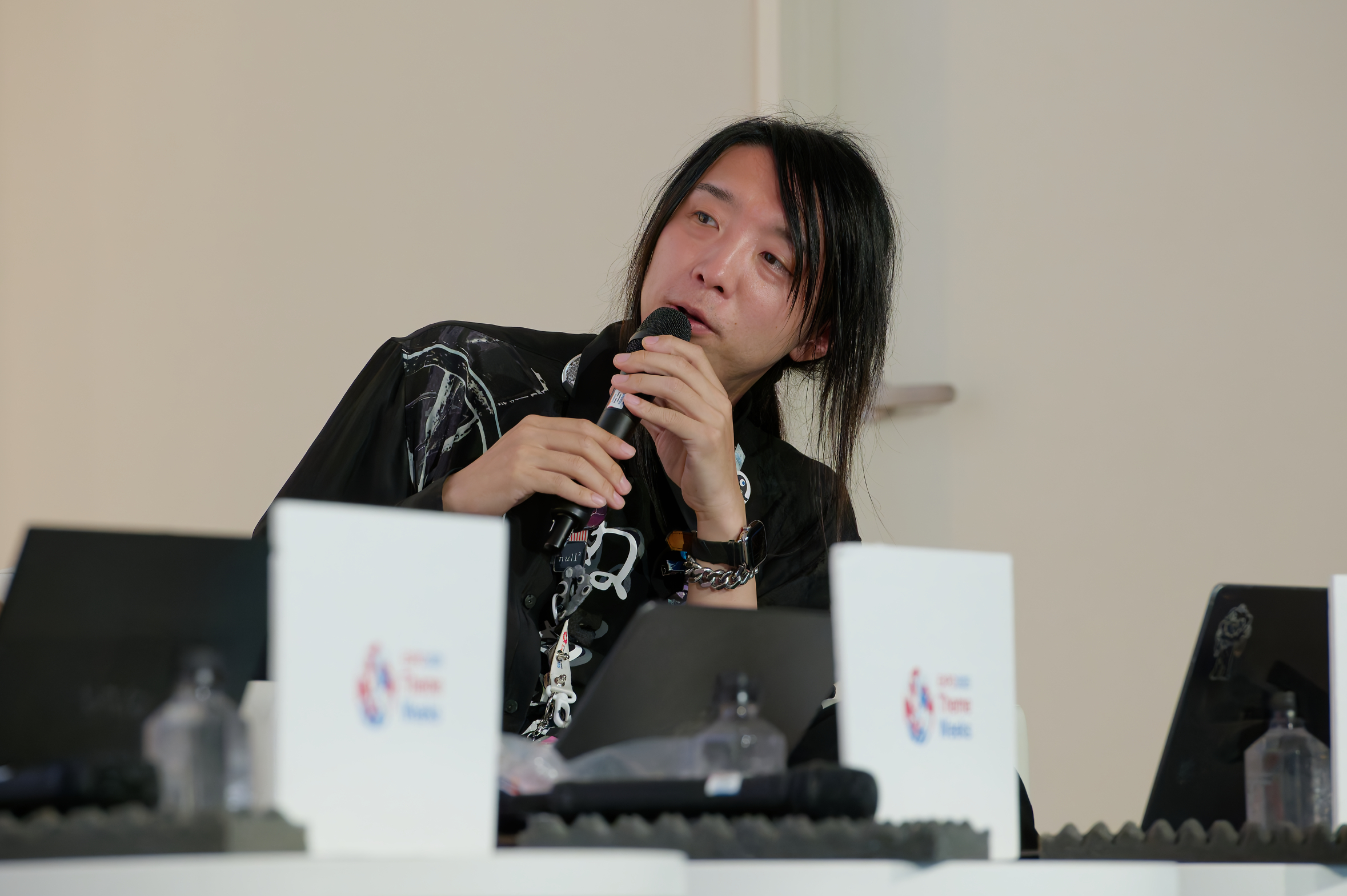
【Speaker Summary: Yoichi Ochiai】
Media artist Yoichi Ochiai reexamined the relationships
between humans and technology, matter and time, and memory
through his Signature Pavilion “null².” He described the Expo
not as a temporary event, but as “a living, evolving
organism,” a project that continues to change as visitors and
creators weave connections within it.
Ochiai envisioned the entire venue as “an organic network of
circulating consciousness and information,” praising the
self-driven participation of citizens and youth on social
media. “Even when major media were indifferent,” he recalled,
“citizens themselves generated enthusiasm. That is the new
form of a ‘Future Society for Our Lives.’”
He recounted how, during the pavilion’s operation, fragments
of the pavilion’s membrane were distributed through
crowdfunding. Many visitors expressed a desire for “used
pieces” rather than new ones—a sentiment that deeply moved
him. “Scars,” he said, “are where memories reside.” These
fragments became not mere materials, but symbols of shared
experience and collective memory.
Behind this idea lies Ochiai’s aesthetic principle that
“matter gains value only when touched, used, and changed over
time.” He explained, “Recycling is meaningless without people.
True recycling is bringing materials back into circulation
after they’ve absorbed human stories and memories.” Through
this, he expanded the SDGs + Beyond framework from material
regeneration to emotional and sensorial circulation.
Drawing on the legacy of Expo ’70, Ochiai cited artists and
architects such as Taro Okamoto, Kenzo Tange, and Arata
Isozaki, whose creations continued to influence their later
work. Likewise, he hoped his pavilion would live on as a
memory within others—an experience to be rediscovered ten or
twenty years later. “If someone laughs one day and says, ‘I
still remember how my skin tingled in the null² Pavilion,’
that will be the legacy,” he smiled, viewing the Expo not as
an ending but as a beginning.
For Ochiai, the brilliance of life lies in shared memory. When
technology and materials are transformed through human touch,
emotion, and time, they attain a kind of vitality. He
concluded, “The future is not about achieving completion—it is
the process of continual transformation itself.” In this
sense, SDGs + Beyond becomes the practice of recycling
emotion, memory, and sensibility as the essence of human
progress.
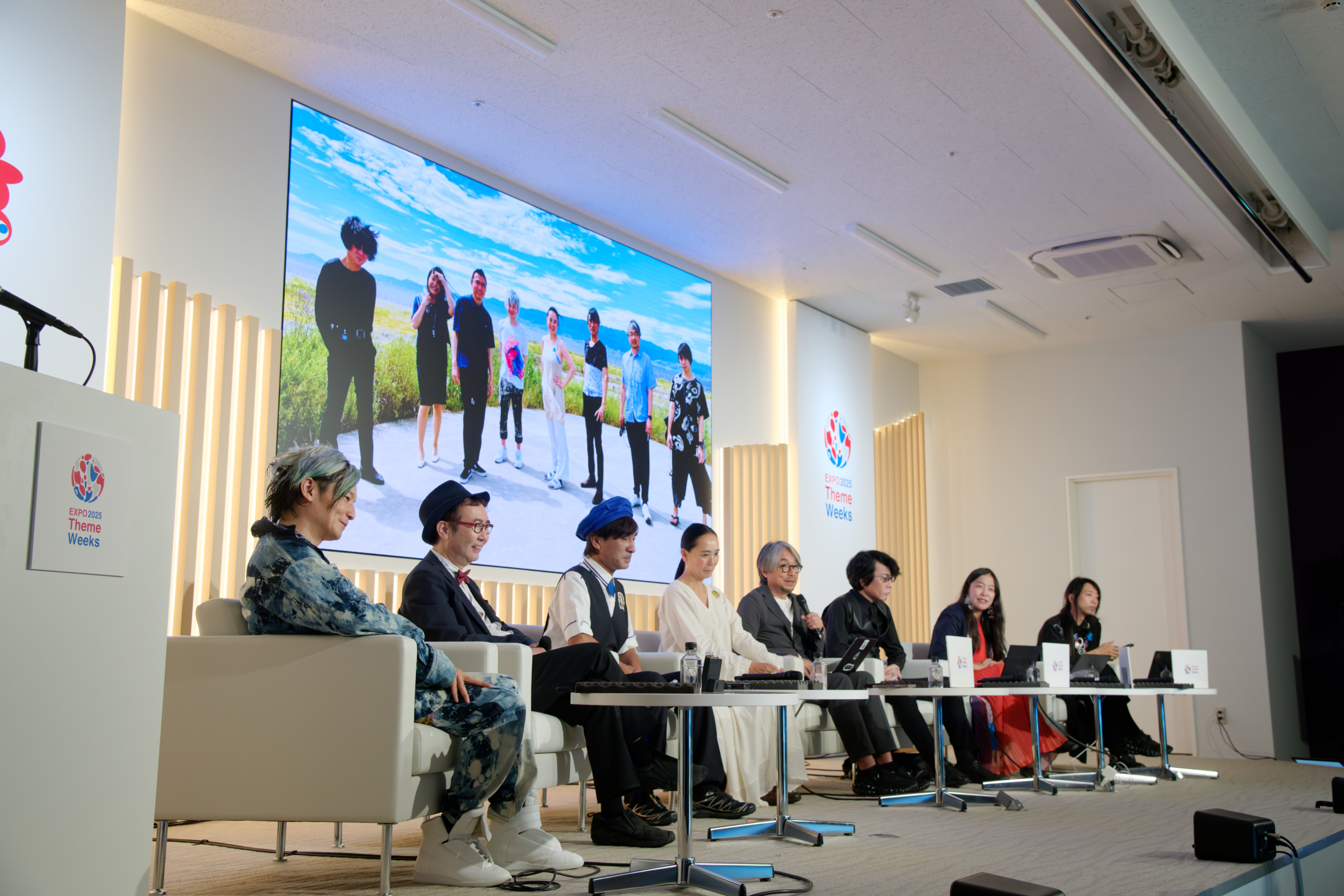
【Discussion Summary】
In the final discussion, the eight producers shared visions of
SDGs + Beyond from their respective fields. Ishiguro argued
that humanity’s next stage is a civilization co-evolving with
AI—a partner that amplifies emotion and intelligence rather
than replacing them. Fukuoka reframed sustainability as
perpetual transformation: “Among 3.8 billion years of life,
humans are the only species failing to sustain themselves.”
Nakajima stated that in the fields of education and human
resource development, what is needed are “the ability to
generate questions” and “playgrounds of diversity where
everyone can mix freely.” She emphasized that creativity (the
power of art) and inclusivity are the essence of what lies
“Beyond.” Kawamori highlighted emotional engagement as the
driver of change, calling for science-art integration. Kawase
spoke of listening as a moral act that fosters empathy across
divides. Koyama envisioned peace at the dining table through
gratitude for all life. Ochiai stressed redesigning ethics and
aesthetics in an era where digital media expands human
sensibility. Miyata summarized that “Beyond is a
civilizational challenge to redesign the relationships of life
itself.” The dialogue bridged technology and art, ethics and
economy, intellect and emotion—marking a shift from an age of
“maintaining sustainability” to one of “resonating and
co-creating.” The participants concluded that the future will
not be built by a single genius but by collective creators,
committing to a civilization centered on the resonance of
life.
Cast
Speakers
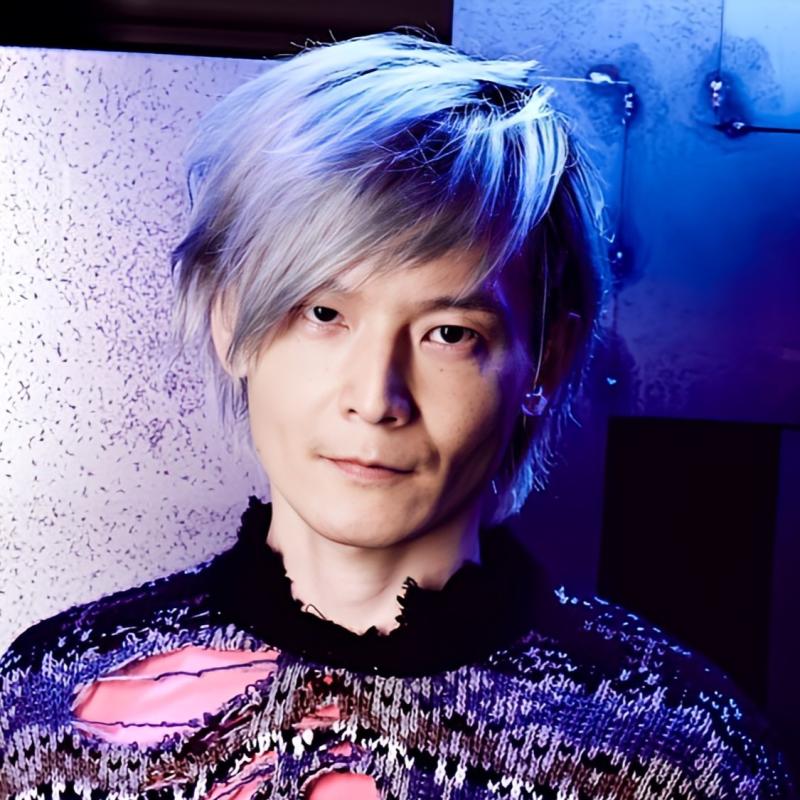
Hiroaki Miyata
Professor, Keio University
Specialises in data science, scientific methodology,
and value co-creation;
His research revolves around promoting social reform
through utilising data science and other scientific
methods to change society for the better. Is involved
in a range of projects in and outside the field of
medicine, such as the National Clinical Database
involving 5,000 hospitals around Japan in
collaboration with the medical specialist system and
the nationwide COVID-related LINE surveys led by the
Ministry of Health, Labour, and Welfare. Also works
with the Keidanren and World Economic Forum to develop
a new vision of society. One of the visions of society
that Miyata has co-created is a “resonant society”
characterised by vibrancy and diversity where each
individual shines through experiencing that world with
others.
View Profile
Close
close
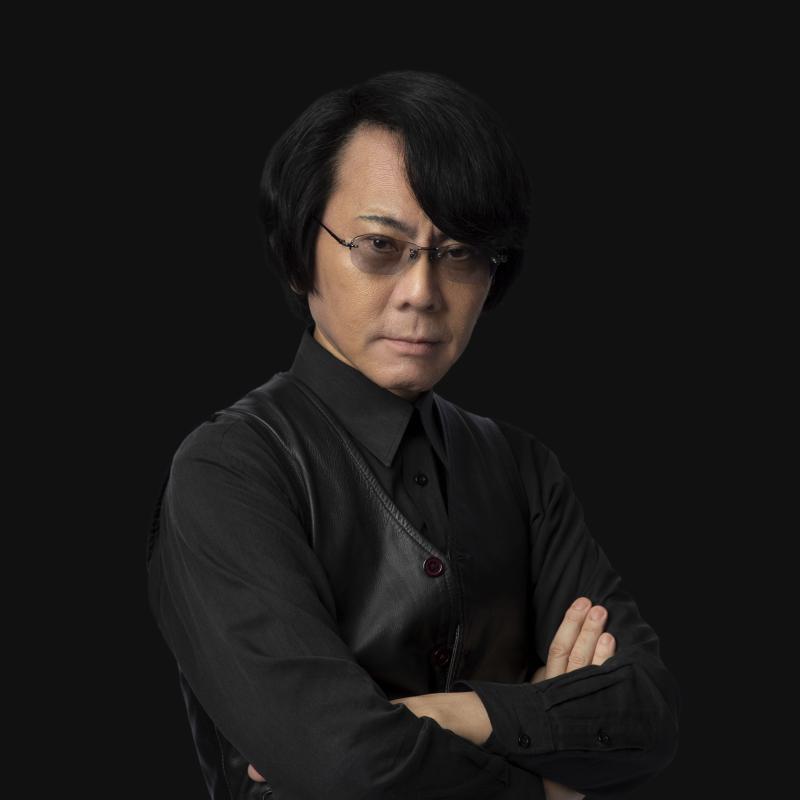
Hiroshi Ishiguro
Professor, Osaka University, Visiting Director, ATR Hiroshi Ishiguro Laboratories
Visiting Director of ATR Hiroshi Ishiguro Laboratories His research interests are interactive robotics, avatar, and android science. Geminoid is an avatar android that is a copy of himself. In 2011, he won the Osaka Cultural Award. In 2015, he received the Prize for Science and Technology by the Minister of Education, Culture, Sports, Science and Technology. He was also awarded the Sheikh Mohammed Bin Rashid Al Maktoum Knowledge Award in Dubai in 2015. Tateisi Award in 2020.
View Profile
Close
close

Sachiko Nakajima
Musician, mathematician and STEAM educator
Sachiko Nakajima is a musician, a mathematics researcher, and a STEAM Educator. She is also CEO of steAm, Inc., and a thematic project producer of Expo 2025, Osaka, Kansai, Japan. She also serves as a STEM Girls Ambassador, Cabinet Office. She won the gold medal as the first Japanese woman in the International Mathematical Olympiad. She passionately conducts research on art and technology as well as music, mathematics, and education.
View Profile
Close
close
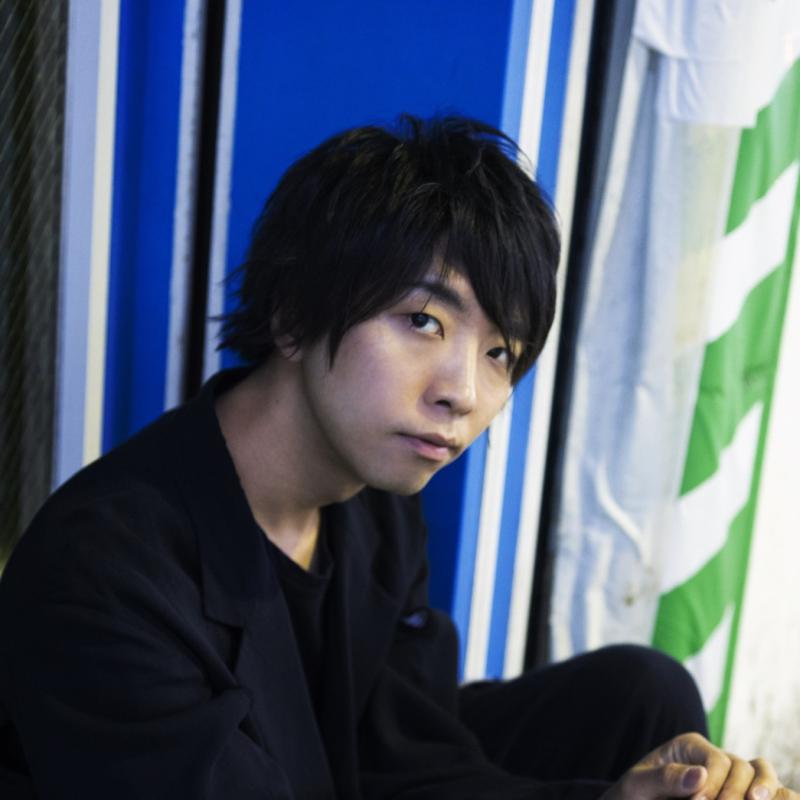
©蜷川実花
Yoichi Ochiai
Media Artist
Yoichi Ochiai was born in 1987, began working as an artist around 2010. His work is based on the motifs of materialization, transformation, and the longing for mass in the boundary realms. Associate Professor at the University of Tsukuba. He has served as a producer of the theme project for the 2025 Japan EXPO in Osaka and Kansai.
View Profile
Close
close
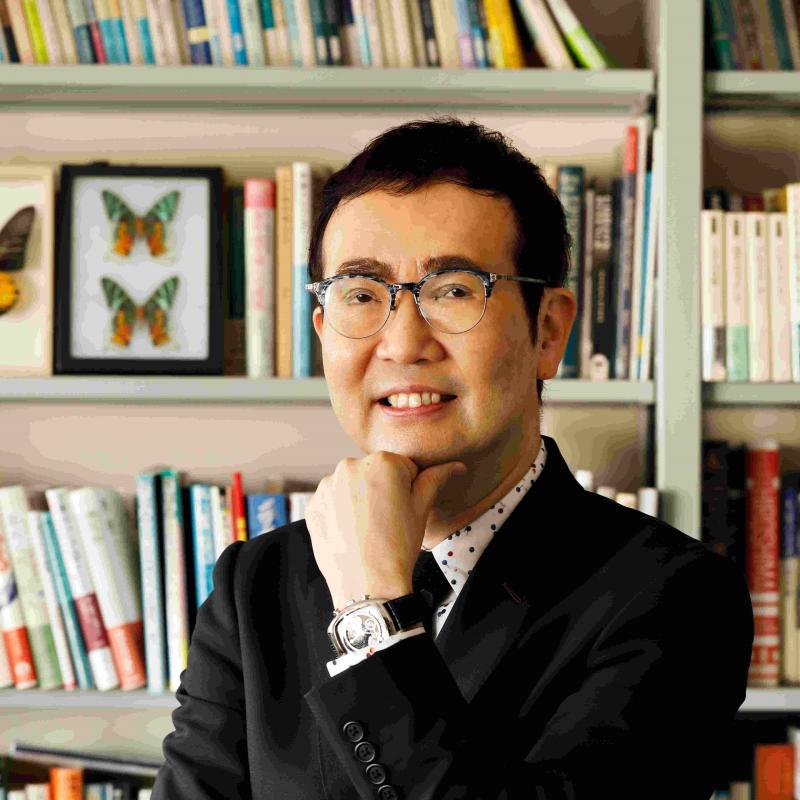
Shin-ichi Fukuoka
Biologist, Professor,Aoyama Gakuin University
Shin-ichi Fukuoka was born in Tokyo in 1959. He is a biologist, an author, a professor at Aoyama Gakuin University,and a visiting professor at Rockefeller University in the U.S.A.
View Profile
Close
close
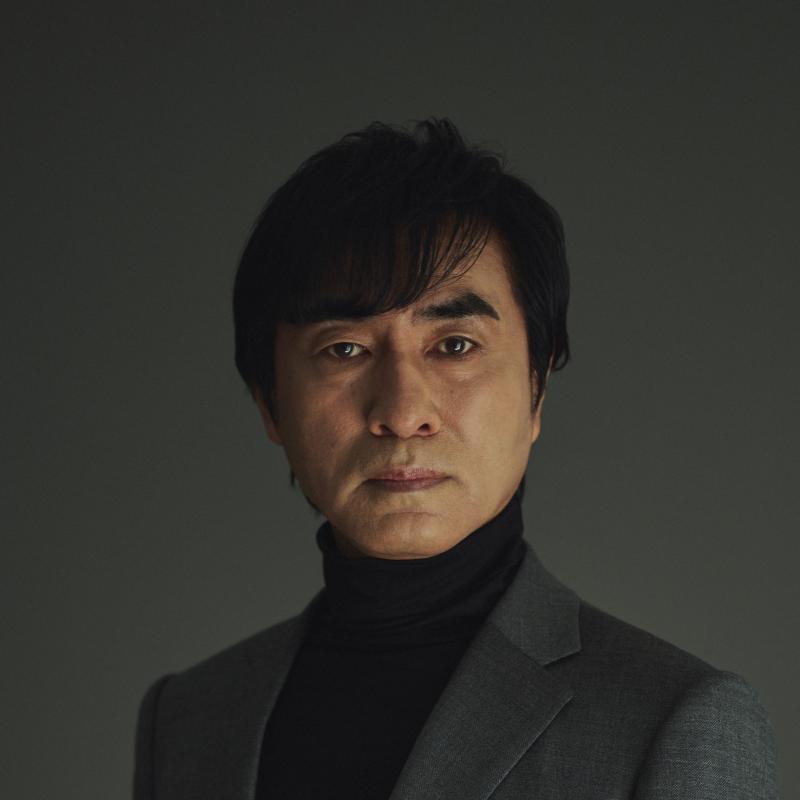
Shoji Kawamori
Animation Director, Mechanic Designer, Vision Creator
Vision creator who is an animation director, planner,
original developer, screenwriter, film/stage producer,
and mechanical designer.
Was one of the original creators of the TV animation
series Super Dimension Fortress Macross during his
years at Keio University, also designing the
three-stage transforming mecha called Valkyrie that
appears in the series. Chosen as director of the opera
film Macross: Do You Remember Love? at the age of only
23. Other than the Macross series, he is the original
creator and director of works such as Earth Maiden
Arjuna as well as the Aquarion series. As a mechanical
designer, he has participated in Mobile Suit Gundam
0083: Stardust Memory, Ghost in the Shell, Cyber
Formula and Armored Core as well as designing Sony’s
entertainment robot “AIBO ERS-220”, the powered suit
“DUALIS” in Nissan’s Dualis commercial and the Sony
smartwatch “wena”.
View Profile
Close
close
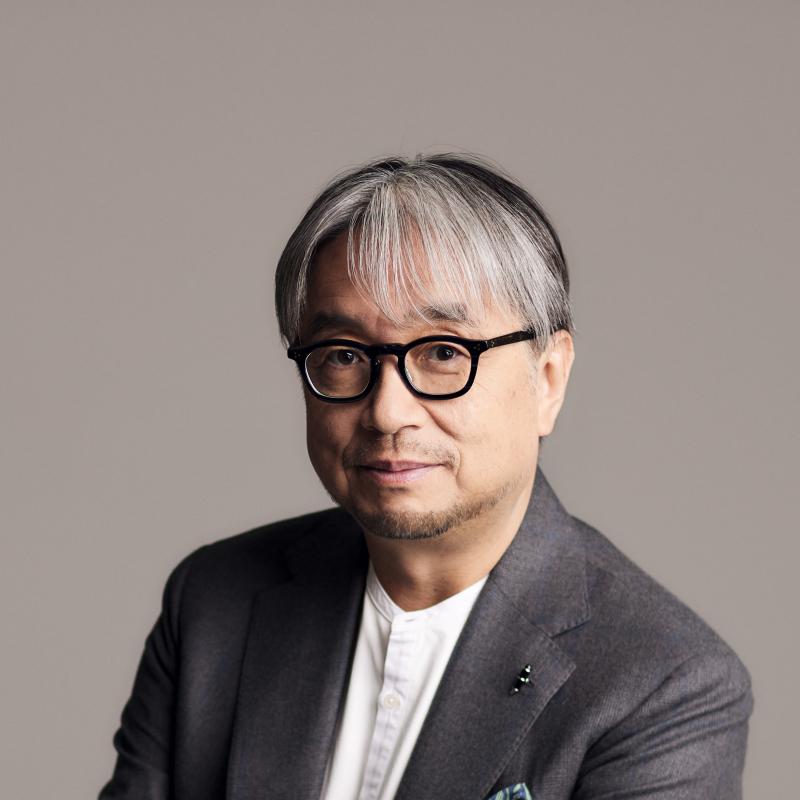
Kundo Koyama
Broadcast writer,Vice President of Kyoto University of the Arts
First started as a broadcast writer during his years at Nihon University College of Art. Has been involved in developing novel TV shows such as Iron Chef, Kanossa no kutsujoku [Road to Canossa], and Sekai isan [World Heritage]. Won the Screenplay of the Year Award at the 32nd Japan Academy Film Prize and the Best Foreign Language Film Award at the 81st Academy Awards for the film Okuribito [Departures]. Has served as a planning committee member for the Agency of Cultural Affairs’ Japan Cultural Expo, panel judge for the Ministry of Agriculture, Fisheries and Forestry’s chef award program “Cooking Masters,” and general producer for RED U-35, one of Japan’s largest competitions for young chefs, among others. Has also participated in numerous regional revitalisation projects, including producing Kumamoto Prefecture’s mascot Kumamon and serving as director of Kyotokan in Kyoto.
View Profile
Close
close
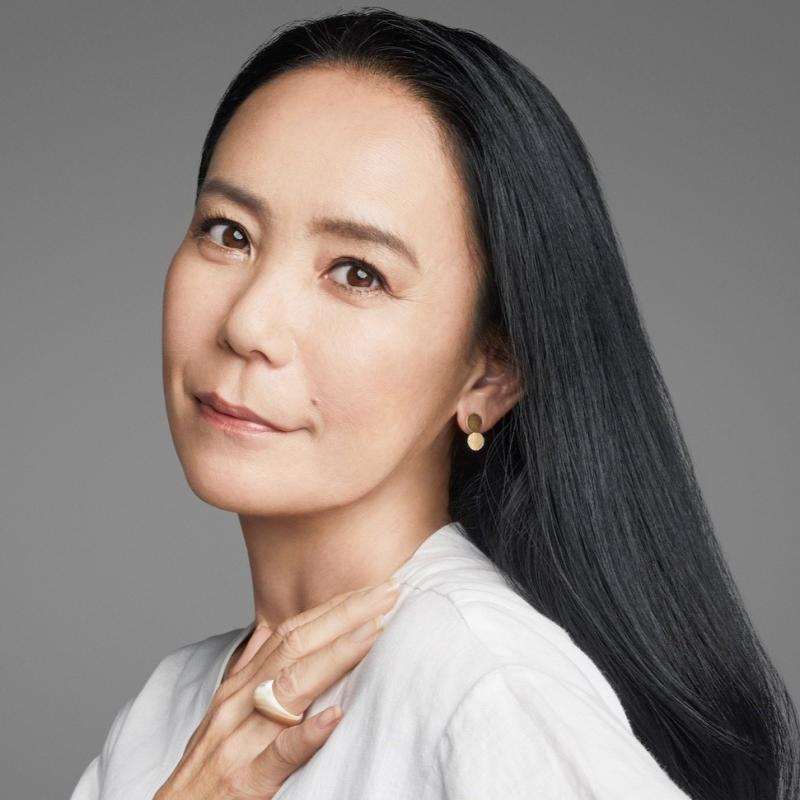
©LESLIE KEE
Naomi Kawase
Filmmaker
A filmmaker based in her native Nara, where she continues to create films. Her consistent pursuit of “reality” transcends the boundaries of both documentary and fiction, earning recognition at top-tier festivals including Cannes, even as she expands her artistic reach globally. In 2010, she launched the Nara International Film Festival in her hometown and remains actively involved in nurturing upcoming filmmakers. She serves as Senior Advisor and Theme Producer for Expo 2025 Osaka, Kansai, as well as UNESCO Goodwill Ambassador. Her latest feature film, “Tashika ni Atta Maboroshi” (Yakushima’s Illusion), will be released nationwide on February 6, 2026.
View Profile
Close
close
SDGs+Beyond Future Society for Life Week
Life and the SDGs + Beyond: A Dialogue with Eight Thematic Project Producers
The programme, together with the General Sponsors, explores: 'What insights can be drawn from the reflections by the Thematic Projects (Signature Pavilions) producers for Our Lives and SDGs+Beyond?'
-
2025.10.12[Sun]
13:30~15:00
(Venue Open 13:00)
- Theme Weeks Studio
OTHER PROGRAM
SDGs+Beyond Future Society for Life Week