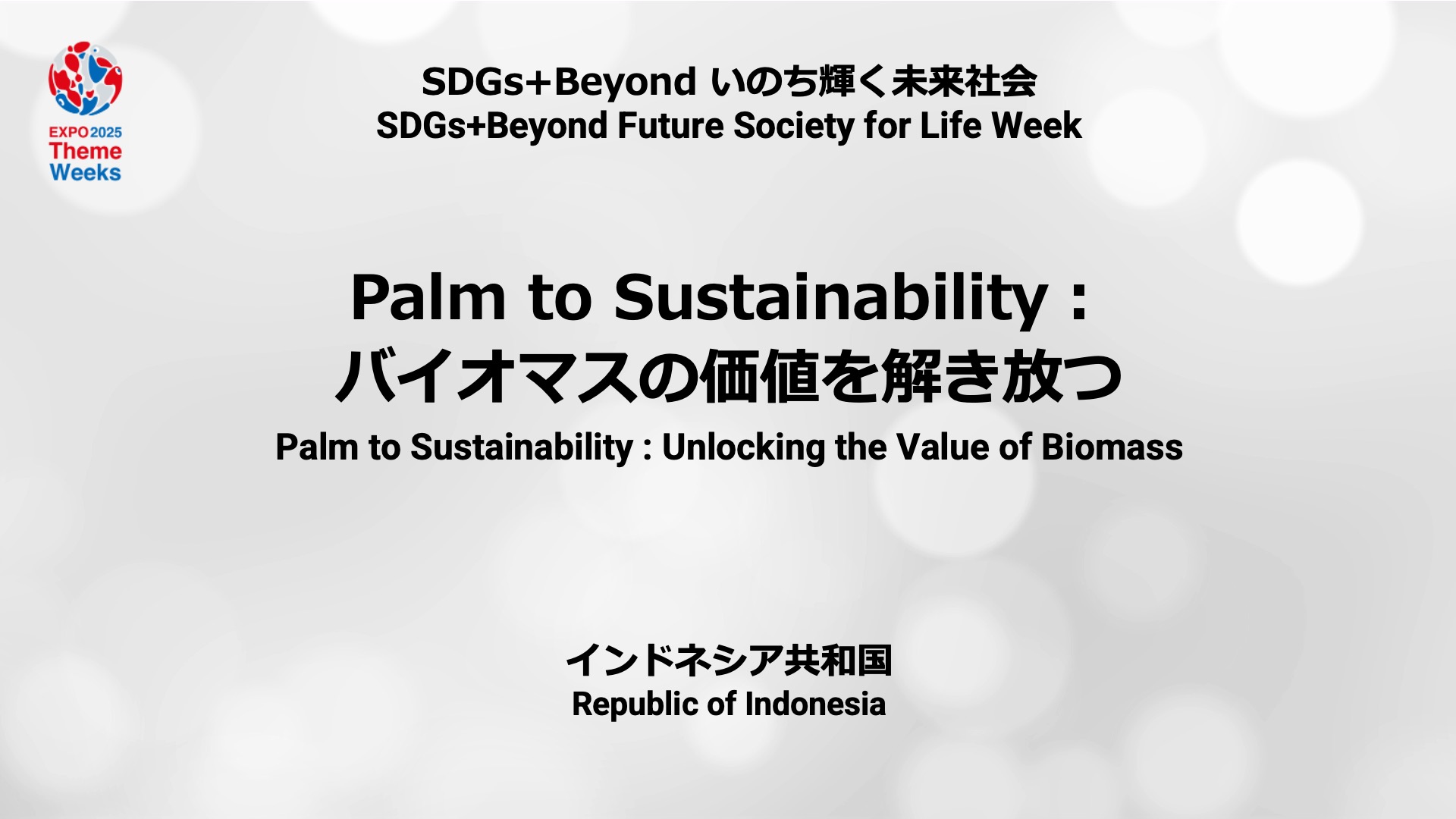
SDGs+Beyond Future Society for Life Week
Palm to Sustainability : Unlocking the Value of Biomass
Republic of Indonesia
This programme highlights Indonesia’s unique advantage as
one of the world’s leading palm oil producers, focusing on
the sustainable utilisation of palm oil by-products to
support the global agenda for decarbonisation and renewable
energy. By transforming palm kernel shells (PKS), previously
considered agricultural residue, into high-value resources,
the initiative aims to strengthen Indonesia’s downstream
biomass industry and attract foreign investment.
The programme also seeks to foster business collaboration
with energy stakeholders worldwide, particularly in Japan,
while building a positive image of Indonesian palm oil as a
key component of global sustainability solutions.
Recorded video available
Discussion
- SDGs
| Transmission of simultaneous interpretation | Provided |
|---|---|
| Language of interpretation | Japanese and English |
-

Track Programme
-
Time and
Date of
the event -
-
2025.10.10[Fri]
10:00 ~ 12:00
(Venue Open 09:30)
-
- Venue
- Pavilion
- Indonesia Pavilion
Programme details
*Subtitles: Choose “Subtitles/CC” in the “Settings” (gear
icon) at the bottom right of the YouTube video.
*Subtitles may not show with multiple languages or overlapping
audio.
The programme will be conducted in a talk-show format. It will
commence with opening remarks by the MC, followed by a welcome
address from the Consul General of Osaka.
Next, Mr Eddy Abdurrachman from the Indonesian Plantations
Fund (IPF) will present on the role of IPF in supporting
bioenergy development in Indonesia. Following this, Mr Dikki
Akhmar of the Association of Palm Kernel Shell Entrepreneurs
of Indonesia will deliver a presentation on the potential of
palm biomass.
To conclude, a panel discussion and Q&A session will
provide participants with the opportunity to exchange views,
exploring international investment opportunities and the
prospects for long-term partnerships.
The programme will focus on key topics such as environmental
sustainability, value-added potential, cost-competitiveness,
and abundant resources, offering participants valuable
insights into new business opportunities and avenues for
international collaboration.
Reports
【Reflection】
This programme shared with participants the potential of a
sustainable packaging industry using by-products generated
from Indonesia’s palm oil sector. Materials such as palm
seeds, branches and leaves remaining after fruit harvesting,
and even trunks and fibres, which were previously regarded as
waste, were presented as valuable resources that could be
utilised as renewable energy or solid fuel. In particular,
palm seed shells can be used to generate steam or electricity,
potentially reducing approximately 0.94 tonnes of carbon
dioxide per tonne. The programme provided participants with an
opportunity to reflect on the contribution of such measures to
a decarbonised society. Similarly, it was shown that if
processed appropriately, branches and trunks could help reduce
greenhouse gas emissions, offering participants a chance to
consider environmental sustainability in practice.
Speakers from the Indonesian Palm By-products Entrepreneurs
Association and the Plantation Fund introduced the types of
resources, export standards, current certification systems,
and practical business cases. As an example of collaboration
with Japanese companies, This Engineering demonstrated how
discarded palm by-products are repurposed as solid fuel,
contributing to local employment and economic revitalisation.
Through Q&A sessions and panel discussions, participants
were able to exchange views on international investment
opportunities and long-term partnerships, providing insights
into new business perspectives and international
collaboration.
Overall, the programme offered participants a platform to
appreciate the potential of sustainable use of palm oil
by-products, while also highlighting technological and
institutional challenges. It also encouraged reflection on the
need for cooperation regarding international certification
systems and export expansion, which stands out as a key
outcome of the programme.
【Post EXPO Initiatives】
Following the forum, the development of sustainable businesses
utilising palm by-products in Indonesia has continued at both
domestic and international levels. At the corporate level,
companies such as This Engineering are expanding operations
that process palm seed shells and fruit branches into solid
fuel, aiming to provide stable supply to power plants and
contribute to reductions in carbon dioxide emissions. In
particular, processing branches into solid fuel to curb
greenhouse gas emissions is attracting interest among domestic
and international stakeholders and businesses.
The Indonesian government has also been strengthening
sustainability certification systems and negotiating for
international recognition. These measures are expected to
support export expansion and attract overseas investment.
Information sharing among CPO mills and businesses is also
progressing, enabling the proper use of by-products based on
scientific evidence and stabilising supply in line with
plantation development. In addition, corporate collaboration
and technological cooperation are anticipated to generate
social benefits such as local economic revitalisation and job
creation.
Looking ahead, it will be important for companies, government
agencies, and international organisations to work together to
promote the sustainable use of palm by-products, reducing
environmental impact through technological innovation and
policy coordination. As export standards and certification
systems are further developed, trade opportunities with
countries including Japan are expected to expand, providing
models for a sustainable packaging industry and renewable
energy initiatives. Building on this programme, efforts to
maximise the value of Indonesia’s by-product resources are
expected to continue growing both domestically and
internationally.
*Part or all of this report was generated by AI.
SDGs+Beyond Future Society for Life Week
Palm to Sustainability : Unlocking the Value of Biomass
This programme highlights Indonesia’s unique advantage as one
of the world’s leading palm oil producers, focusing on the
sustainable utilisation of palm oil by-products to support the
global agenda for decarbonisation and renewable energy. By
transforming palm kernel shells (PKS), previously considered
agricultural residue, into high-value resources, the
initiative aims to strengthen Indonesia’s downstream biomass
industry and attract foreign investment.
The programme also seeks to foster business collaboration with
energy stakeholders worldwide, particularly in Japan, while
building a positive image of Indonesian palm oil as a key
component of global sustainability solutions.
-
2025.10.10[Fri]
10:00~12:00
(Venue Open 09:30)
- Pavilion
OTHER PROGRAM
SDGs+Beyond Future Society for Life Week