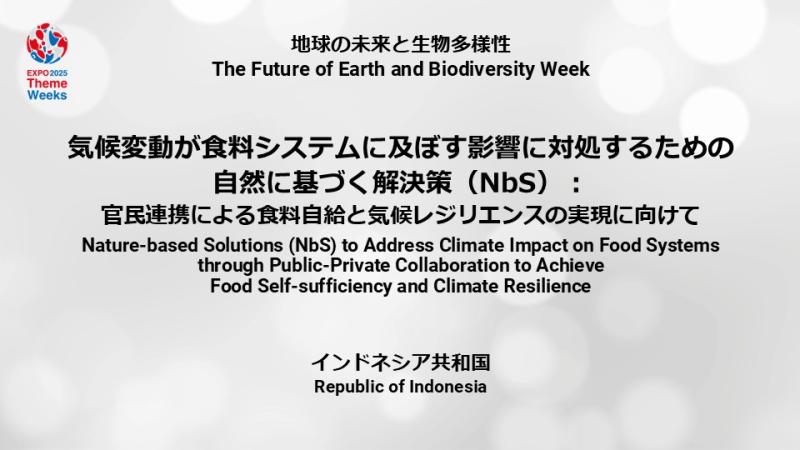
The Future of Earth and Biodiversity Week
Indonesia Green Gold Projects Agroforestry Nyamplung Bioenergy and Decarbonization
Republic of Indonesia
The Nyamplung Agroforestry Program is a Nyamplung tree planting program, a forest plant that can produce bioenergy and biopharmaceuticals. Nyamplung plants can decarbonize to reduce carbon emissions and greenhouse gas emissions. Nyamplung plants can be one solution to climate change and the energy transition from fossil to non-fossil energy. Nyamplung trees can be planted on critical or non-productive land such as ex-mining reclamation land, peat land, and conservation land.
Recorded video available
Discussion
- Decarbonisation
- Biodiversity
- Others
- Green Industry
| Transmission of simultaneous interpretation | Provided |
|---|---|
| Language of interpretation | Japanese and English |
-

Track Programme
-
Time and
Date of
the event -
-
2025.09.17[Wed]
16:00 ~ 18:00
(Venue Open 15:30)
-
- Venue
- Pavilion
- Indonesia Pavilion
Programme details
*Subtitles: Choose “Subtitles/CC” in the “Settings” (gear
icon) at the bottom right of the YouTube video.
*Subtitles may not show with multiple languages or overlapping
audio.
The Indonesia Green Gold Project Agroforestry Nyamplung
Bioenergy and Decarbonization aims to support climate change
mitigation by cultivating Nyamplung trees (Calophyllum
inophyllum) for carbon sequestration, bioenergy production,
and decarbonization. The project is aligned with
Indonesia's Nationally Determined Contributions (NDCs)
under the Paris Agreement and COP29. The primary goals include
enhancing carbon capture through agroforestry, producing
sustainable bioenergy, contributing to decarbonization
efforts, and generating economic value through carbon trading
and bioenergy production. Additionally, the project supports
bilateral carbon trading between Indonesia and Japan under the
Mutual Recognition Arrangement (MRA). So that we get Climate
Justice, Social Justice and Economic Justice, Nature, Culture
and Future. Profit, People and Planet.
The project is structured into several phases: 1) Planning
& Stakeholder Engagement – aligning with regulatory
frameworks such as Presidential Regulation No. 98 of 2021, and
forming necessary partnerships; 2) Site Selection &
Planting – choosing suitable regions, planting Nyamplung
trees, and training local communities; 3) Bioenergy Production
& Decarbonization – harvesting trees for bioenergy and
reducing emissions; 4) Carbon Trading & Economic Impact –
generating and trading carbon credits via the Indonesian
Carbon Exchange; and 5) Monitoring & Reporting – tracking
the project’s environmental impact. The project will run for
18 months for phases 1-3, with ongoing monitoring and scaling,
and key performance indicators include carbon sequestration,
bioenergy production, carbon credits, and local economic
impact.
Reports
【Reflection】
At Expo 2025 Osaka, the Indonesian green enterprise Pandu
Vijaya Nagara presented the “Indonesia Green Gold Project”.
The project makes use of Nyamplung (Calophyllum inophyllum),
an evergreen tree native to Indonesia’s coastal regions, which
is widely used for oil, building materials, and other
purposes. Through a combination of agroforestry
practices—planting trees alongside crops—renewable energy
initiatives, and collaboration with local communities, the
project aims to address climate change while promoting
sustainable economic growth.
The exhibition highlighted how planting Nyamplung on degraded
or underutilised land can absorb carbon dioxide, improve soil
quality, and prevent erosion, while also generating various
commercial products such as Nyamplung oil for pharmaceuticals
and cosmetics. In addition, in partnership with Indonesia’s
National Research and Innovation Agency (BRIN), the
measurement and certification of carbon credits have been
scientifically validated, demonstrating that they can be
traded internationally.
According to the project’s presentation, using Nyamplung is
expected to reduce approximately 1.4 million tonnes of CO₂
annually, contributing to regional economic revitalisation and
job creation. Visitors showed strong interest in this concrete
example of nature-based climate action. The initiative was
also highly regarded as an innovative model that balances
sustainability with community co-prosperity by generating
economic value in collaboration with local communities.
Furthermore, the executive distributor model allows
participants to engage in carbon trading with reduced
investment risk and high transparency, which attracted
significant attention from both visitors and investors.
The introduction of the project at Expo 2025 provided an
important opportunity to showcase Indonesia’s use of natural
resources and its sustainable economic model to audiences both
domestically and internationally.
【Post EXPO Initiatives】
Following the Expo, Pandu Vijaya Nagara has continued to
expand and strengthen the project, building on the momentum
generated by the presentation. In the Gunungkidul region, the
initiative aims to plant Nyamplung trees over 2,500 hectares,
collaborating closely with local communities to manage the
trees, harvest biomass for bioenergy, and support economic
development. These efforts not only restore degraded lands but
also contribute to employment creation and local economic
growth, demonstrating a practical model for inclusive and
sustainable development.
The project has introduced a mechanism for international
carbon credit trading through an executive distributor model,
which allows investors to purchase carbon rights and related
products without owning the land, thereby reducing risk while
facilitating transparent and verifiable trading. Additionally,
the production of low-methane livestock feed and soil
enhancement materials derived from Nyamplung trees supports
environmental conservation and improved agricultural
productivity, further benefiting local communities.
These ongoing activities align closely with Indonesia’s
Nationally Determined Contributions (NDCs) under the Paris
Agreement and the United Nations Sustainable Development Goals
(SDGs), promoting climate action, social inclusion, and
sustainable economic growth simultaneously. By fostering
partnerships with domestic and international organisations,
the project continues to strengthen Indonesia’s presence in
the global carbon market while demonstrating how nature-based
solutions can deliver measurable environmental, social, and
economic benefits.
The post-Expo initiatives highlight Pandu Vijaya Nagara’s
commitment to scaling sustainable land restoration and carbon
reduction efforts, creating a model that can inspire
replication in other regions facing similar climate and
environmental challenges.
The Future of Earth and Biodiversity Week
Indonesia Green Gold Projects Agroforestry Nyamplung Bioenergy and Decarbonization
The Nyamplung Agroforestry Program is a Nyamplung tree planting program, a forest plant that can produce bioenergy and biopharmaceuticals. Nyamplung plants can decarbonize to reduce carbon emissions and greenhouse gas emissions. Nyamplung plants can be one solution to climate change and the energy transition from fossil to non-fossil energy. Nyamplung trees can be planted on critical or non-productive land such as ex-mining reclamation land, peat land, and conservation land.
-
2025.09.17[Wed]
16:00~18:00
(Venue Open 15:30)
- Pavilion
OTHER PROGRAM
The Future of Earth and Biodiversity Week