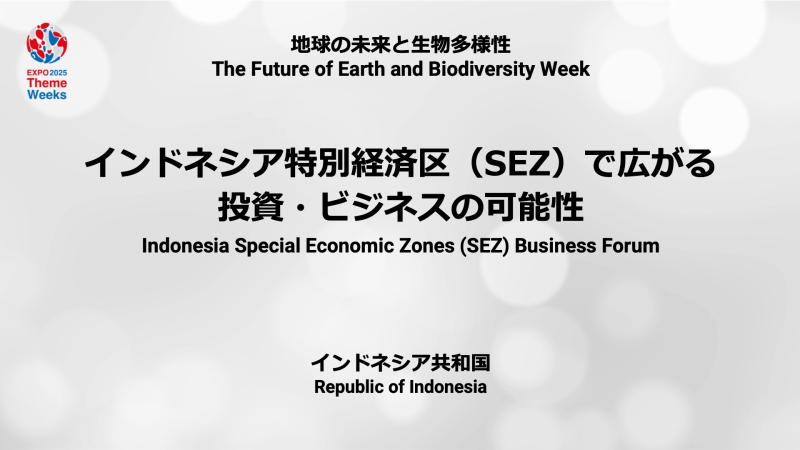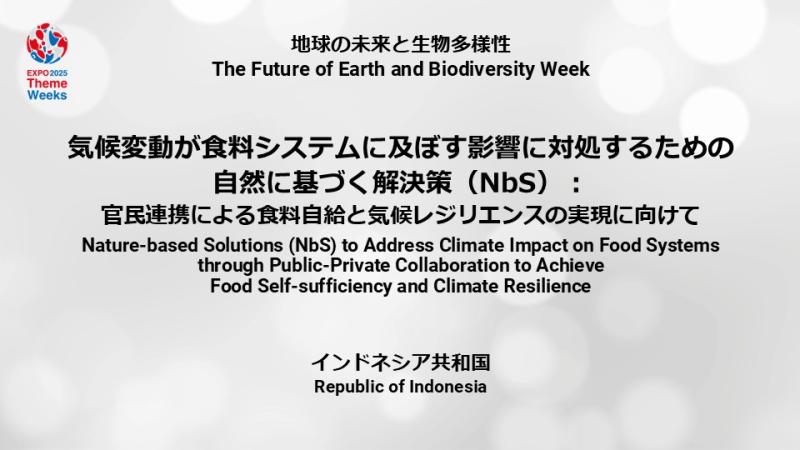
The Future of Earth and Biodiversity Week
Sustainable Landscapes: Integrated Forest, Water, and Biodiversity for Growth
Republic of Indonesia
This session will explore strategies to overcome sectoral fragmentation within the Government of Indonesia and strengthen regulatory frameworks for sustainable land use and environmental management of forests, water resources, and biodiversity. With support from international development partners, the session will also aim to build robust partnerships and platforms for adaptive Integrated Landscape Management (ILM) across pilot landscapes.
Recorded video available
Discussion
- Climate change
- Nature Positive
- Deforestation
| Transmission of simultaneous interpretation | Provided |
|---|---|
| Language of interpretation | Japanese and English |
-

Track Programme
-
Time and
Date of
the event -
-
2025.09.25[Thu]
10:00 ~ 12:00
(Venue Open 09:30)
-
- Venue
- Pavilion
- Indonesia Pavilion
Programme details
*Subtitles: Choose “Subtitles/CC” in the “Settings” (gear
icon) at the bottom right of the YouTube video.
*Subtitles may not show with multiple languages or overlapping
audio.
Objectives
- Overcome sectoral fragmentation within the Government of
Indonesia and enhance regulatory frameworks for the
sustainable management of forests, water resources, and
biodiversity
- Build partnerships and platforms for adaptive Integrated
Landscape Management (ILM) in pilot landscapes
Target Audience
- Government representatives from Japan and around the
world
- International organisations and development partners from
Japan and worldwide
- Private sector (agribusiness, green finance, technology,
etc.)
- Academia and research institutions
- Civil society and non-governmental organisations (NGOs)
- General Expo visitors interested in sustainability issues
Reports
【Reflection】
The business forum, “Sustainable Landscapes: Integrating
Forests, Water and Biodiversity for Growth”, brought together
stakeholders from the Indonesian government, international
organisations, NGOs, private sector, and local communities.
Discussions highlighted the importance of an integrated
approach to simultaneously achieve environmental protection
and economic growth. In the opening keynote, a UN Special
Envoy for Water emphasised the central role of water
management and explained that integrating forests, water and
biodiversity is essential for achieving the SDGs. The need for
collaboration among diverse stakeholders to improve community
livelihoods and food security was also stressed.
Subsequent sessions presented cross-ministerial coordination
models and alignment of plans from local to national levels,
illustrating policies designed to balance biodiversity
conservation with economic development. The forum highlighted
the three pillars of biodiversity protection—ecosystem
maintenance, species and genetic resource conservation, and
sustainable use—and explained how these can be integrated
across agriculture, tourism, and rural development.
The forum also emphasised the importance of knowledge sharing
and partnership building through the involvement of NGOs,
local communities, and the private sector. Practical examples
included community-led nursery management, use of non-timber
forest products, and transparent management combining
financing and technological innovation. These initiatives
demonstrate how economic incentives can be aligned with
ecosystem conservation, providing a clear picture of
sustainable landscape management in practice.
The forum reaffirmed that close collaboration across
government, civil society, and local communities is essential
to achieve both environmental protection and economic
prosperity. Sharing experiences among participants offered
guidance for future policies and projects, creating a strong
foundation for implementing sustainable landscape management
models nationally and internationally. The outcomes provide
significant momentum for advancing integrated landscape
management in Indonesia and beyond.
【Post EXPO Initiatives】
Following the forum, the Indonesian government and partners
have been actively advancing initiatives to implement and
expand sustainable landscape strategies integrating water,
forests, and biodiversity. Policies under the 2025–2029
medium-term plan are promoting sustainable use of forests,
agriculture, and marine resources, aiming to achieve economic
growth while enhancing environmental value. The FOLU (Food,
Land Use and Restoration) project is expanding methods to
improve agricultural productivity alongside forest
conservation, contributing to reduced CO₂ emissions and
regional economic development.
NGOs and the private sector are preparing to scale up
participatory landscape management models nationwide.
Initiatives such as forest restoration, use of non-timber
forest products, and community-led nursery management combine
practical approaches with economic incentives to support both
community self-reliance and ecosystem protection. Advanced
technologies, including AI, remote sensing, and GIS, are
strengthening monitoring systems, improving transparency, and
enabling more data-driven decision-making in sustainable
landscape management.
Measures are also being developed to address land-use
conflicts, including respect for indigenous rights,
stakeholder dialogue, and use of scientific data and mapping.
Combined with approaches such as social forestry,
agroforestry, and ecotourism, these efforts are helping to
establish national model cases of sustainable landscape
management.
Indonesia’s initiatives are expected to influence
international practice as well. The forum’s examples and
policy frameworks provide a foundation for knowledge sharing
and cooperation with other countries, showcasing integrated
landscape management as a model for balancing sustainable
economic growth and ecosystem conservation globally.
*Part or all of this report was generated by AI.
The Future of Earth and Biodiversity Week
Sustainable Landscapes: Integrated Forest, Water, and Biodiversity for Growth
This session will explore strategies to overcome sectoral fragmentation within the Government of Indonesia and strengthen regulatory frameworks for sustainable land use and environmental management of forests, water resources, and biodiversity. With support from international development partners, the session will also aim to build robust partnerships and platforms for adaptive Integrated Landscape Management (ILM) across pilot landscapes.
-
2025.09.25[Thu]
10:00~12:00
(Venue Open 09:30)
- Pavilion
OTHER PROGRAM
The Future of Earth and Biodiversity Week