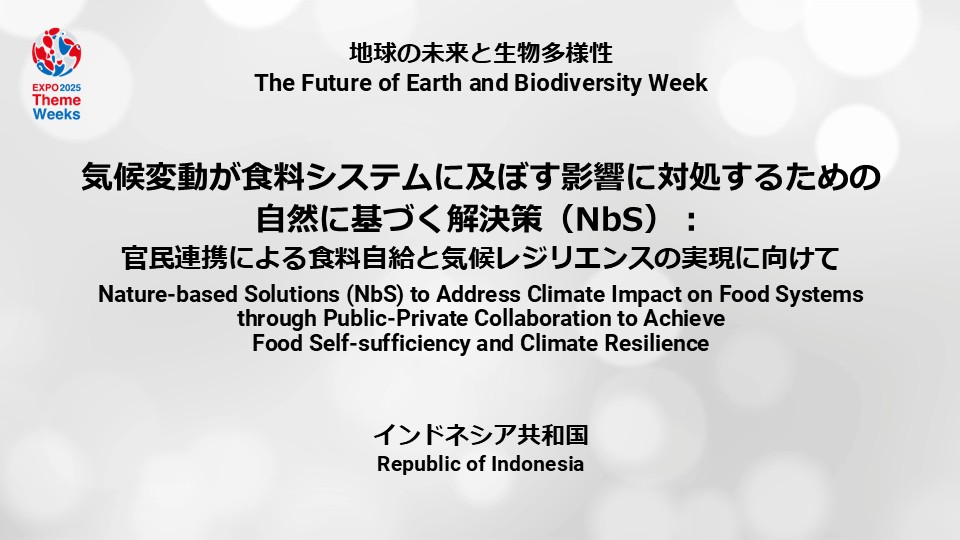
The Future of Earth and Biodiversity Week
Nature-based Solutions (NbS) to Address Climate Impact on Food Systems through Public-Private Collaboration to Achieve Food Self-sufficiency and Climate Resilience
Republic of Indonesia
This session, “Nature-based Solutions (NbS) to Address the
Impact of Climate Change on Food Systems,” will explore
approaches to enhance food self-sufficiency and climate
resilience through public–private collaboration in response
to the challenges posed by climate change to agriculture and
food systems.
It aims to integrate smallholder farmers into sustainable
value chains to promote responsible production and
strengthen economic resilience. The session will also
encourage cooperation among governments, financial
institutions, and technology providers to advance the
mainstreaming of Nature-based Solutions (NbS) and the
development of resilient food systems.
Recorded video available
Discussion
- Climate change
- Biodiversity
- Decarbonisation
| Transmission of simultaneous interpretation | Provided |
|---|---|
| Language of interpretation | Japanese and English |
-

Track Programme
-
Time and
Date of
the event -
-
2025.09.26[Fri]
16:00 ~ 18:00
(Venue Open 15:30)
-
- Venue
- Pavilion
- Indonesia Pavilion
Programme details
*Subtitles: Choose “Subtitles/CC” in the “Settings” (gear
icon) at the bottom right of the YouTube video.
*Subtitles may not show with multiple languages or overlapping
audio.
Objectives:
To integrate smallholder farmers into responsible and
sustainable commodity value chains, promoting economic
resilience and improved production practices through Good
Agricultural Practices (GAP) and Good Handling Practices
(GHP).
To explore how governments, financial institutions, and
technology providers can work together to align regulatory
frameworks, mobilise blended finance, and strengthen
institutional coordination in order to promote the adoption of
Nature-based Solutions (NbS) and resilient food systems in
Indonesia and beyond.
Target Audience:
Government representatives from Japan and around the world
Representatives of international organisations and development
partners
Private sector participants (agribusiness, green finance,
technology, etc.)
Members of academia and research institutions
Representatives of civil society and non-governmental
organisations (NGOs)
General Expo visitors with an interest in sustainability
Reports
【Reflection】
The business forum on "Nature-based Solutions (NbS) to
Address the Impacts of Climate Change on Food Systems"
highlighted Indonesia’s efforts to enhance the resilience and
sustainability of its food systems in the face of climate
change.
The forum showcased concrete examples of NbS, including the
adoption of agroforestry, conservation of mangroves and coral
reefs, and the development of multifunctional urban green
spaces. These initiatives emphasised the importance of working
with nature to establish a climate-resilient food production
system.
During panel discussions, participants explored practical
measures to support smallholder farmers, such as improving
productivity, expanding market access, providing technical
assistance, and innovating financing mechanisms. Notably, the
mediated partnership model in the coffee and cocoa sector
demonstrated how collaboration between farmers, experts, and
industry can enhance product quality and facilitate entry into
premium markets, thereby stabilising farmers’ incomes and
promoting sustainable supply chains.
The forum also highlighted the “finance valley” challenge,
where mid-sized funding gaps exist, and emphasised that
cooperatives and pipeline financing are essential to scaling
up. The integration of policy, finance, technology, and
multi-stakeholder collaboration was confirmed as critical for
the nationwide expansion of NbS.
Furthermore, the forum discussed how responding to the EU
Deforestation Regulation (EUDR) could strengthen sustainable
production systems and international competitiveness,
providing a practical roadmap that links policy with
on-the-ground implementation.
【Post EXPO Initiatives】
Following the forum, participants and relevant institutions
have been actively advancing the adoption of NbS and support
for smallholder farmers.
Technical training and field support are being implemented
nationwide, promoting sustainable practices such as
agroforestry, soil improvement, and diversified income
sources.
In the coffee and cocoa sectors, the mediated partnership
model continues to combine expert guidance with market
development, encouraging quality management, GI certification,
and entry into premium markets, directly contributing to
farmers’ income stability and local economic growth.
To address the “finance valley” challenge, cooperative
formation and value chain integration are being promoted to
create effective financing pipelines, with collaboration
between government, financial institutions, and private sector
actors exploring new financial mechanisms.
Additionally, trade authorities and related agencies are
leveraging the EUDR as an opportunity to strengthen
sustainable production systems and enhance international
market competitiveness, improving access to high-standard
markets such as Japan.
These ongoing efforts accelerate the nationwide expansion of
NbS through multi-sector collaboration, supporting both food
security and the economic prosperity of local communities,
while advancing environmental conservation. Continued
collaboration and the scaling-up of practical initiatives are
expected to play a pivotal role in building a sustainable
society.
*Part or all of this report was generated by AI.
The Future of Earth and Biodiversity Week
Nature-based Solutions (NbS) to Address Climate Impact on Food Systems through Public-Private Collaboration to Achieve Food Self-sufficiency and Climate Resilience
This session, “Nature-based Solutions (NbS) to Address the
Impact of Climate Change on Food Systems,” will explore
approaches to enhance food self-sufficiency and climate
resilience through public–private collaboration in response to
the challenges posed by climate change to agriculture and food
systems.
It aims to integrate smallholder farmers into sustainable
value chains to promote responsible production and strengthen
economic resilience. The session will also encourage
cooperation among governments, financial institutions, and
technology providers to advance the mainstreaming of
Nature-based Solutions (NbS) and the development of resilient
food systems.
-
2025.09.26[Fri]
16:00~18:00
(Venue Open 15:30)
- Pavilion
OTHER PROGRAM
The Future of Earth and Biodiversity Week