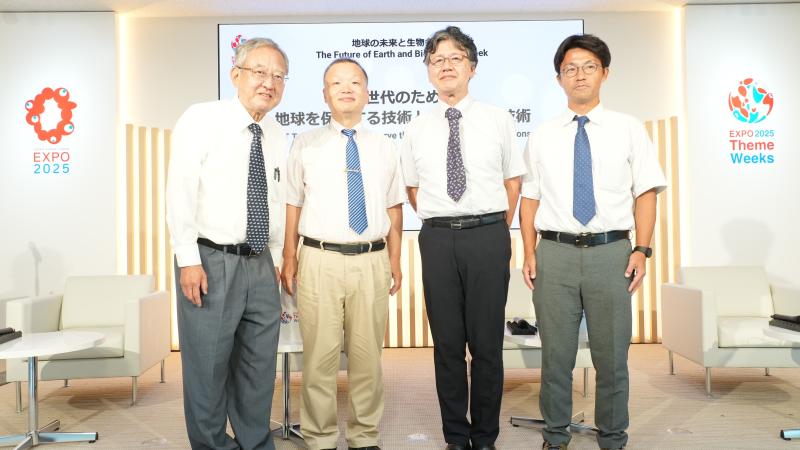
The Future of Earth and Biodiversity Week
Green cities and better ways of living thorough sustainability and aesthetics - the New European Bauhaus
European Union
Cities are central to the green transition, serving as
laboratories where environmental policies deliver tangible
results for citizens.
This session, framed by the New European Bauhaus (NEB), will
explore what makes a city truly green: circular economy
practices, nature-based solutions, sustainable architecture,
and adaptation to climate challenges. Commissioner Roswall’s
portfolio areas—water management, resilience, and circular
economy—will feature alongside inspiring examples from
European Green Capitals and pioneering Japanese cities. The
dialogue will address reducing single-use plastics,
rethinking public spaces, and the interplay of local
initiatives and national regulation. In its second part, the
session will focus on the NEB as a movement linking
sustainability, aesthetics, and inclusion, highlighting
Europe–Japan collaboration in sustainable design and
architecture.
Recorded video available
Discussion
- Circular economy
| Transmission of simultaneous interpretation | Provided |
|---|---|
| Language of interpretation | Japanese and English |
-

Track Programme
-
Time and
Date of
the event -
-
2025.09.22[Mon]
13:30 ~ 15:00
(Venue Open 13:15)
-
- Venue
- Pavilion
- EU Pavilion
Programme details
*Subtitles: Choose “Subtitles/CC” in the “Settings” (gear
icon) at the bottom right of the YouTube video.
*Subtitles may not show with multiple languages or overlapping
audio.
With contributions from European Green Capital winners and
Japanese city pioneers, the dialogue will explore how cities
across continents are tackling pressing issues — such as
reducing single-use plastics and transforming public spaces —
and the role of both local initiatives and national regulators
in driving change. The session will underline the real
benefits of green urban policies: enhanced quality of life,
efficient resource use, stronger community ties and a more
supportive business environment.
In the second part of the session, the spotlight will turn
more directly to the New European Bauhaus — a European
movement that fuses sustainability, aesthetics and social
inclusion. As the NEB aims to open up to participants beyond
the EU, architects from Europe and Japan will join
Commissioner Roswall to discuss how sustainably built
architecture shapes greener cities and improves the daily
lives of citizens.
In the spirit of the NEB and practical sustainability, this
exchange will also ask how can small-scale projects contribute
to broader urban transformation? And where can Europe and
Japan converge in their visions for sustainable design and
architecture?
Building resilient and green cities through international
collaboration
Moderator: Jean-Eric Paquet, EU Ambassador to Japan
Jessika Roswall, Commissioner for Environment, Water
Resilience and a Competitive Circular Economy, European
Commission
Margot Roose, Deputy Mayor of Tallinn
Takeharu Yamanaka, Mayor of Yokohama City, Japan
Hideyuki Yokoyama, Mayor of Osaka City, Japan
Designing sustainable futures – The New European Bauhaus in
practice
Moderator: Marcos Ros Sempere MEP, Co-rapporteur on the New
European Bauhaus
Jessika Roswall, Commissioner for Environment, Water
Resilience and a Competitive Circular Economy, European
Commission
Shigeru Ban, Architect
Albert Edman, Head of Development, RISE Research Institutes of
Sweden
Reports
【Reflection】
Framed by the New European Bauhaus (NEB)
values—sustainability, aesthetics and inclusion—the session
examined what makes a city truly green, focusing on circular
practices, nature-based solutions, sustainable architecture,
and adaptation to climate challenges. Water management,
resilience, and circular economy were highlighted, alongside
examples from European Green Capitals and pioneering Japanese
cities.
Key findings
Connect circular operations with public-space redesign.
Making collection, sorting and reuse a default in urban
operations should go hand-in-hand with rethinking streets and
public facilities.
Combine nature-based infrastructure with architectural
quality.
Greening and rain-garden measures can be deployed with
sustainable building practices to deliver environmental
benefits and better lived experience.
Leverage multi-level governance and EU–Japan collaboration.
City initiatives scale faster when supported by enabling
policies and shared learning across regions.
Conclusion
The session, aligned with NEB values, organised the concrete
elements that make cities greener—circular practice,
nature-based solutions, sustainable architecture and climate
adaptation— and shared examples from Europe and Japan, with
emphasis on water management and resilience.
【Post EXPO Initiatives】
Implementation focus
Aligned with the session, actions should progress across urban
operations, public-space design, sustainable architecture, and
governance/collaboration.
Priority actions
Integrate circular practices in public spaces: reduce
single-use plastics and redesign collection/sorting flows in
venues and civic facilities.
Introduce nature-based measures: rainwater use, greening and
shading features, with clear maintenance rules.
Apply sustainable architecture more broadly: require both
environmental performance and design quality in
refurbishment/new builds; track user experience.
EU–Japan peer learning: set up city-to-city reviews with
European Green Capitals and Japanese peers using shared
assessment lenses (liveability, resilience, circular
practice).
Make results visible: curate qualitative/quantitative
indicators on water, resilience and circularity and share them
regularly.
Conclusion
This anchors NEB values in a scalable portfolio of city
projects and makes progress tangible for residents and
partners.
Cast
Moderator

Jean-Eric Paquet
EU Ambassador to Japan
View Profile
Close
close
Marcos Ros Sempere
Member of the European Parliament
View Profile
Close
close
Speakers
Jessika Roswall
Commissioner for Environment, Water Resilience and a Competitive Circular Economy, European Commission
View Profile
Close
close
Margot Roose
Deputy Mayor of Tallinn, Estonia
View Profile
Close
close
Takeharu Yamanaka
Mayor of Yokohama City
View Profile
Close
close
Hideyuki Yokoyama
Mayor of Osaka City
View Profile
Close
close
Shigeru Ban
Architect
View Profile
Close
close
Albert Edman
Head of Development, RISE Research Institutes of Sweden
View Profile
Close
close
The Future of Earth and Biodiversity Week
Green cities and better ways of living thorough sustainability and aesthetics - the New European Bauhaus
Cities are central to the green transition, serving as
laboratories where environmental policies deliver tangible
results for citizens.
This session, framed by the New European Bauhaus (NEB), will
explore what makes a city truly green: circular economy
practices, nature-based solutions, sustainable architecture,
and adaptation to climate challenges. Commissioner Roswall’s
portfolio areas—water management, resilience, and circular
economy—will feature alongside inspiring examples from
European Green Capitals and pioneering Japanese cities. The
dialogue will address reducing single-use plastics, rethinking
public spaces, and the interplay of local initiatives and
national regulation. In its second part, the session will
focus on the NEB as a movement linking sustainability,
aesthetics, and inclusion, highlighting Europe–Japan
collaboration in sustainable design and architecture.
-
2025.09.22[Mon]
13:30~15:00
(Venue Open 13:15)
- Pavilion
OTHER PROGRAM
The Future of Earth and Biodiversity Week